What Are Research Peptides?
Peptides are short chains of amino acids. Many of the body's signalling molecules are peptides, which is why they are studied so widely: a peptide can bind a specific receptor and influence a defined biochemical pathway rather than acting broadly across systems.
In a laboratory setting, peptide research usually means measuring something specific — receptor binding and activation, downstream signalling, changes in a measurable marker in cell culture, or defined endpoints in animal or human studies. Different compounds have been investigated for very different reasons, so the strength of the evidence behind one peptide says nothing about the evidence behind another.
That difference is the single most important thing to keep in view. Some compounds have large randomised human trials behind them. Others rest mainly on cell-culture work. A finding in a dish or in a rodent model describes what happened in that model; it is not a demonstrated human outcome, and it should not be read as one.
Each article in the Origen Research Library labels the evidence level it is describing for exactly that reason.
Origen materials are supplied for laboratory research use only. Nothing on this page is medical advice, and no dosing, administration or personal-use guidance is provided.
Research Compounds Covered by Origen
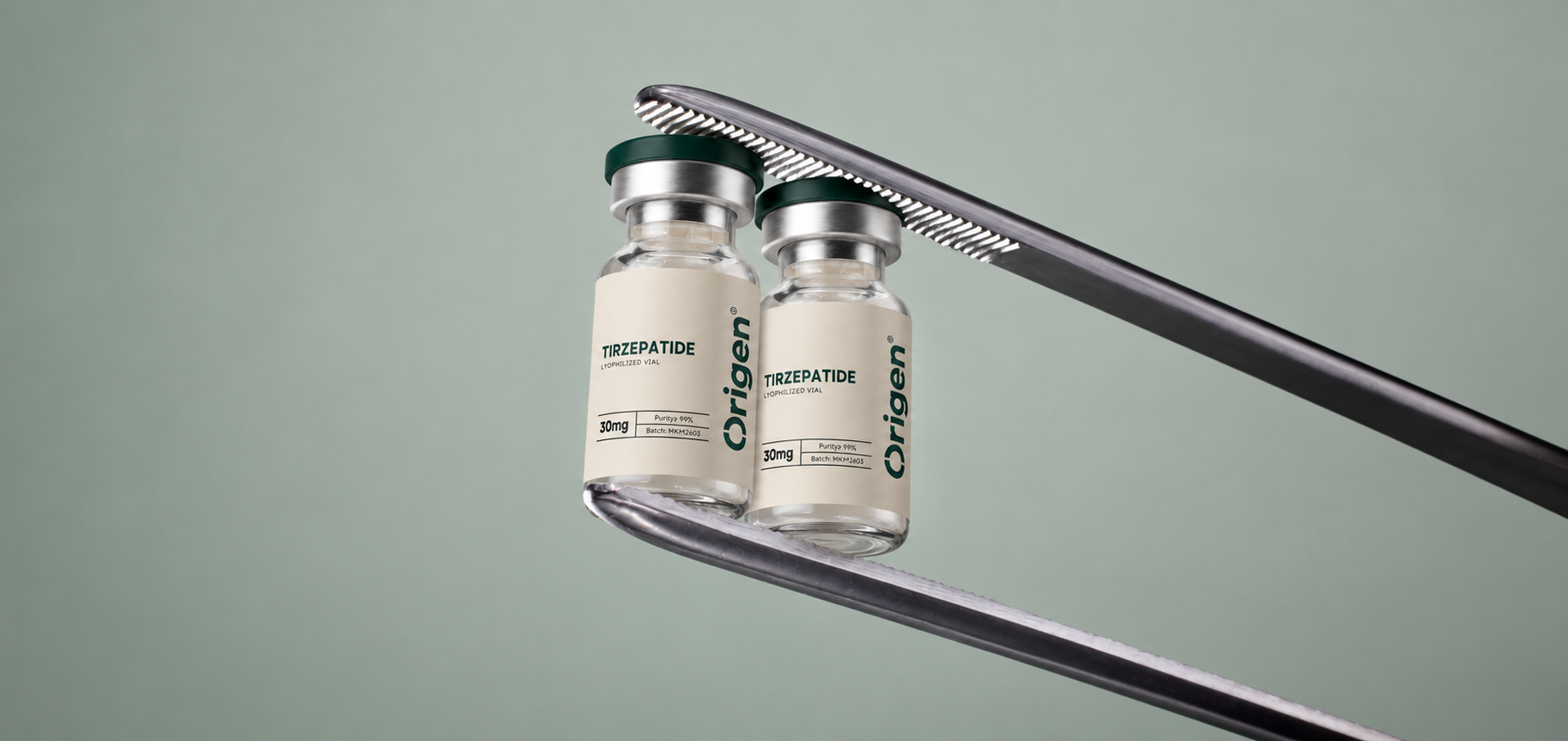
Tirzepatide
Tirzepatide is a single peptide that engages two incretin receptors, GIP and GLP-1. Laboratory work characterised its receptor binding and signalling profile before it entered clinical development, and randomised human trials later measured glycaemic and body-weight endpoints against both placebo and an active comparator. Because it is a marketed medicine in some jurisdictions, its clinical evidence base is unusually well documented for a peptide discussed in research settings. What remains open in the literature is how much each receptor contributes to the observed effects, and how the compound behaves in populations that trials did not enrol.
Explore research: what is tirzepatide, how tirzepatide works, the tirzepatide clinical trial programme, tirzepatide and retatrutide comparison.
Retatrutide
Retatrutide is an investigational triple agonist studied at the glucagon, GIP and GLP-1 receptors. Preclinical pharmacology described the intended contribution of each receptor, and randomised phase 2 trials reported dose-ranging results in obesity and in type 2 diabetes. It is not approved in any jurisdiction, and later-phase results were not peer-reviewed at the time of writing. That distinction matters: phase 2 findings describe what was measured in a defined trial population over a defined period, not a settled clinical conclusion.
Explore research: retatrutide research overview, the retatrutide mechanism, the TRIUMPH trial programme, how the two compounds compare.
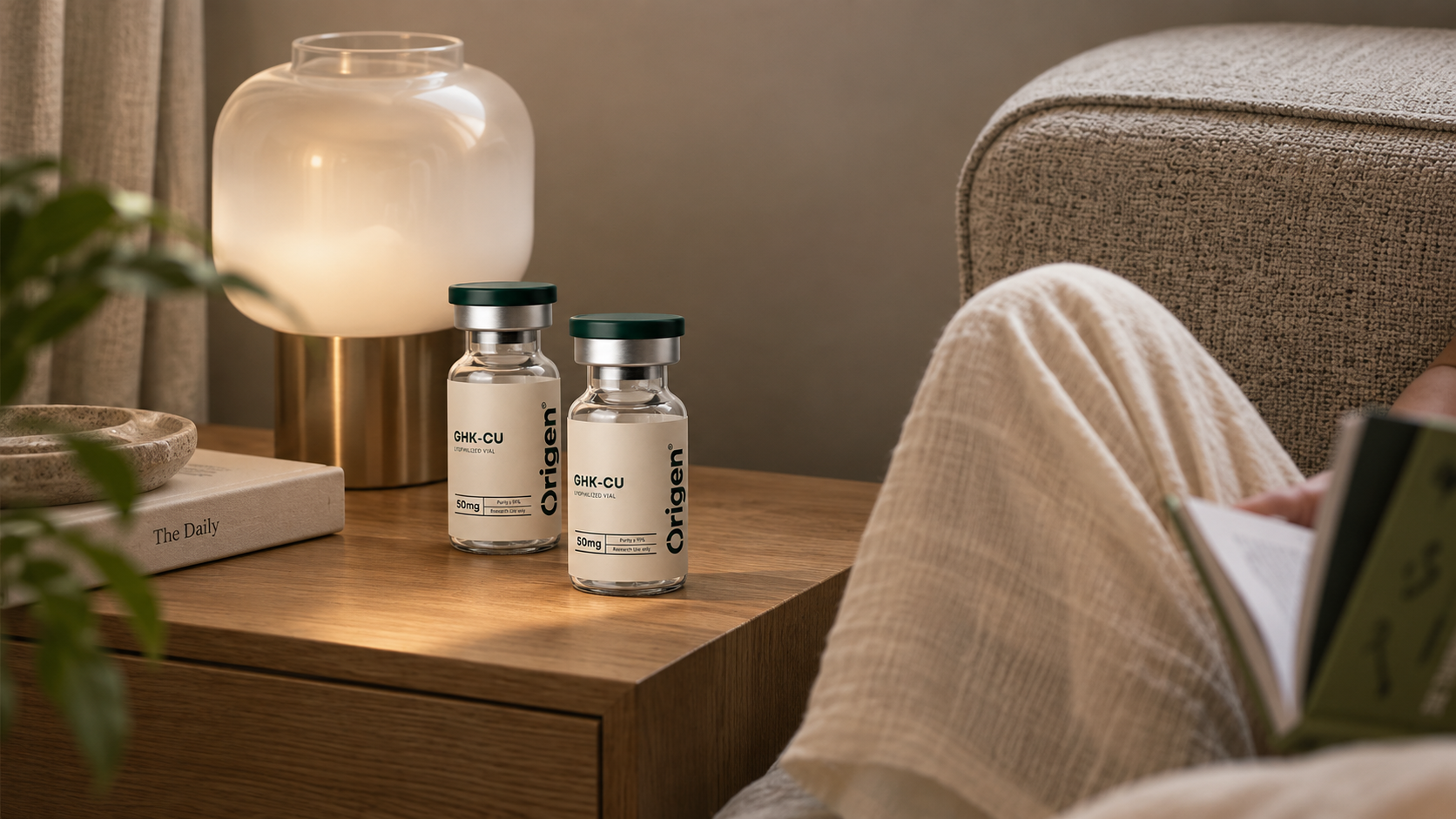
GHK-Cu
GHK-Cu is a copper-binding tripeptide studied mainly in dermatological and wound-repair models. Much of the published work is in vitro, using fibroblast or follicle cultures, with a smaller set of animal studies and a limited number of human investigations. Reported observations include effects on collagen-related signalling in cell culture. The evidence hierarchy is the important part here: cell-culture findings describe what happened in a dish, and they should not be read as demonstrated outcomes in people.
Explore research: what GHK-Cu is, the copper-binding mechanism, GHK-Cu skin research, the follicle literature.
CJC-1295 + Ipamorelin
CJC-1295 and ipamorelin act on two different secretagogue pathways: one a growth-hormone-releasing-hormone analogue, the other a selective ghrelin-receptor agonist. The published record separates CJC-1295 with a drug affinity complex from the version without it, and human data for the two peptides in combination is sparse compared with data for each alone. Articles in this cluster keep those distinctions explicit rather than presenting the pair as a single studied entity.
Explore research: CJC-1295 and ipamorelin research, how each compound works, DAC versus no-DAC, the published evidence review.
Understanding Peptide Purity and Laboratory Testing
"Purity" in analytical chemistry is narrower than it sounds in marketing. It describes the proportion of the detected signal attributable to the target compound in the sample that was submitted, measured by a stated method. High-performance liquid chromatography (HPLC) separates the components of a sample and reports their relative proportions, which is what makes it useful for purity and, alongside other methods, identity assessment.
Identity, content and purity are three different questions. Identity asks whether the material is the peptide it claims to be. Content asks how much peptide mass the vial actually held. Purity asks what proportion of the detected material was the target compound. A report can answer one of these and be silent on the others, so the method section matters as much as the headline number.
A laboratory result also applies to the sample that was submitted and to the batch or product identified in the report's scope. It is not a statement about every vial ever produced or about future production. Nor does an analytical result speak to sterility, clinical safety, efficacy, or suitability for use in people.
This is why reading the actual documentation beats reading a claim about it. Origen publishes its laboratory reports and the identifiers needed to open them at the laboratory itself — see certificates and testing or the verification process.
What Is a Peptide Certificate of Analysis?
A certificate of analysis (COA) is the laboratory's report for a specific submitted sample. Depending on the tests commissioned, it may identify the laboratory, the sample or product analysed, the batch or lot reference, the analytical methods used, the results for each test, the date of testing, and a report or task identifier that allows the document to be located again.
Independent verification matters because a PDF or an image can be edited. A report that can be opened on the issuing laboratory's own infrastructure, using identifiers printed on the report, is a materially stronger document than a screenshot.
How to Verify an Origen Laboratory Report
- Find the product's published report on the certificates page, which lists the lot, the Janoshik Analytical task number and the verification key.
- Open the report link, which is hosted by the laboratory rather than by Origen, or enter the task number and verification key on the laboratory's verification form ↗.
- Compare the lot reference on the report against the lot marked on the vial you are examining. A report belongs to the sample and lot it names.
- Read the method and scope on the report itself, so the result is interpreted against the tests that were actually performed.
Currently published reports cover Retatrutide 30 mg (lot REPTN, task #171909), CJC-1295 (No DAC) / Ipamorelin 10 mg (lot MKM2603, task #136577), GHK-Cu 50 mg (lot QWPW, task #95932) and Tirzepatide 30 mg (lot MKM2603, task #136367).
Research Peptides in the Philippines
Working with research materials locally introduces practical variables that are easy to overlook when reading international literature. Two of them dominate: climate and logistics.
Average daytime temperatures and humidity across most of the country are high year-round. Anything that sits in a vehicle, a sorting facility or a building lobby is exposed to that environment, so the realistic question for a local researcher is not only how a material is stored on arrival but how long it spent in transit and under what conditions. Domestic delivery windows and courier handling are therefore part of the documentation, not separate from it — Origen publishes its own dispatch and transit information on the shipping and delivery page.
Traceability is the second consideration. A lot number that can be matched to a published laboratory report, and a report that can be opened at the laboratory, give a local buyer a way to check a supplier's claims without taking anything on trust. Suppliers that publish neither, or that publish images of reports without verifiable identifiers, cannot be checked the same way.
On regulatory questions, care is warranted. Classification and requirements depend on the specific product and the specific activity, including importation, sale and distribution, and are governed by applicable Philippine law. Origen does not represent its products as approved, registered or authorised medicines, and this page does not offer a legal interpretation. Where the position is unclear for a given activity, the appropriate step is to seek qualified advice rather than to rely on a supplier's characterisation. Origen's compliance policy sets out how its products are positioned and what uses are not supported.
Research Peptide Storage and Handling
Peptides are supplied in different physical forms, and handling requirements follow the form and the compound rather than a single universal rule. Lyophilised material and reconstituted solution do not behave the same way, and published handling information for the specific product should govern.
In practical terms, three things are worth documenting in a local setting: the conditions the material experienced in transit, the conditions it was held in after arrival, and the lot reference tying the material to its laboratory report. Handling and storage guidance for a specific Origen product is published with that product, and the current transit windows are on the shipping and delivery page. Purity and identity documentation for each lot sits on the certificates page.
No preparation, dosing or administration instructions are provided here. Origen materials are not for human or veterinary use.
Explore the Origen Research Library
The Research Library holds longer articles on each compound: receptor mechanisms, the published trial record with its sample sizes and endpoints, direct comparisons where they exist, and an explicit account of what the evidence does not yet show. Every article cites its primary sources.
Two supporting paths run alongside the compound articles. For the receptor biology the incretin literature assumes you already know, start with GLP-1, GIP and glucagon. For how laboratory results should be read before they are trusted, start with peptide purity vs content and how to read a certificate of analysis.