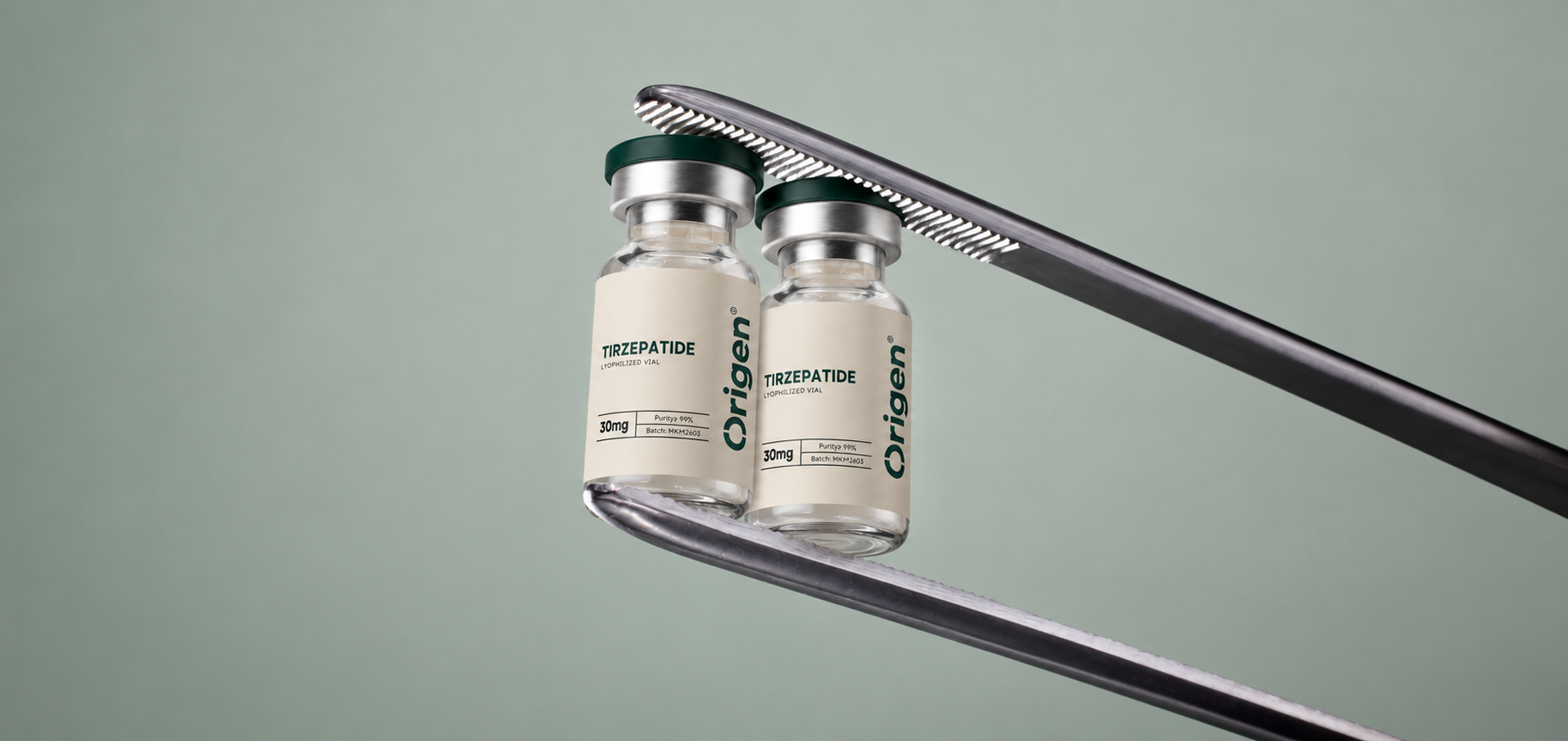
How are the three compounds different?
| Compound | Receptor targets | Evidence stage | Major research programmes | Direct comparison evidence |
|---|---|---|---|---|
| Semaglutide | GLP-1 | Phase 3 complete; cardiovascular outcomes published | STEP, SELECT | Comparator in SURPASS-2 and SURMOUNT-5 |
| Tirzepatide | GIP + GLP-1 | Phase 3 complete across diabetes and obesity | SURPASS, SURMOUNT | Directly compared with semaglutide in two randomised trials |
| Retatrutide | Glucagon + GIP + GLP-1 | Phase 2 published; phase 3 programme underway, no results published | TRIUMPH, TRANSCEND | None published; comparison trials registered only |
Evidence level: human randomised trials and clinical-trial registry records, checked 18 September 2026.
Semaglutide: single-receptor agonism
Semaglutide is a GLP-1 receptor agonist. STEP 1 studied once-weekly semaglutide 2.4 mg against placebo in 1,961 adults with overweight or obesity over 68 weeks, reporting a mean body-weight change of −14.9% with semaglutide versus −2.4% with placebo. [1]
SELECT then tested cardiovascular outcomes in 17,604 adults with overweight or obesity and established cardiovascular disease but without diabetes, reporting a reduction in major adverse cardiovascular events over a mean follow-up of 39.8 months. [2] This is the deepest outcome evidence in the group, and it belongs to the single-receptor compound.
Tirzepatide: dual-receptor agonism
Tirzepatide engages GIP and GLP-1 receptors. [3] SURMOUNT-1 studied 2,539 adults with obesity or overweight without diabetes over 72 weeks, reporting mean weight change of −15.0%, −19.5% and −20.9% at 5 mg, 10 mg and 15 mg respectively, against −3.1% with placebo. [4]
The full programme, including the diabetes trials and the cardiovascular outcomes trial, is covered in tirzepatide clinical trials.
For the receptor pharmacology, see how tirzepatide works.
Retatrutide: triple-receptor agonism
Retatrutide engages glucagon, GIP and GLP-1 receptors. [5] Its published clinical evidence is phase 2. In a 48-week phase 2 obesity trial of 338 adults, the least-squares mean change in body weight at 48 weeks was −24.2% at the 12 mg dose versus −2.1% with placebo. [6] A separate phase 2 trial in people with type 2 diabetes reported smaller weight change, as is typical in that population. [7]
The phase 3 TRIUMPH programme is underway. Several trials have completed enrolment and follow-up, but as of 18 September 2026 no TRIUMPH trial has posted registry results or published peer-reviewed efficacy results.
The current registry position is maintained in retatrutide clinical trials.
For the receptor pharmacology, see how retatrutide works.
What direct head-to-head evidence exists?
This is the section that decides what can honestly be said. Direct evidence means participants randomised, within one trial, to one compound or the other.
| Comparison | Status | What exists |
|---|---|---|
| Tirzepatide vs semaglutide (type 2 diabetes) | Published | SURPASS-2: 1,879 participants, 40 weeks, tirzepatide superior to semaglutide 1 mg on HbA1c and weight reduction [8] |
| Tirzepatide vs semaglutide (obesity) | Published | SURMOUNT-5: 751 participants, 72 weeks, tirzepatide produced greater weight reduction than semaglutide 2.4 mg [9] |
| Retatrutide vs tirzepatide | Registered only | TRIUMPH-5 (NCT06662383) is active and not recruiting; no results posted [10] |
| Retatrutide vs semaglutide | Registered only | TRANSCEND-T2D-2 (NCT06260722) is active and not recruiting; no results posted [11] |
A registered comparison is not a comparison result. TRIUMPH-5 and TRANSCEND-T2D-2 show that the questions are being asked. They do not answer them, and nothing on this page should be read as anticipating their outcome.
The pairwise analyses go deeper than this summary: tirzepatide vs semaglutide.
See also retatrutide vs semaglutide and the two-way tirzepatide comparison.
For the dual-versus-triple question specifically, see tirzepatide vs retatrutide.
Why can't trial percentages simply be ranked?
Because the numbers were produced under different conditions. Placing −14.9%, −20.9% and −24.2% side by side implies they were measured the same way. They were not.
- Population. STEP 1 and SURMOUNT-1 enrolled adults without diabetes; the retatrutide phase 2 obesity trial did too, but the diabetes trials of all three compounds report systematically smaller weight change. [1][4][6][7]
- Baseline characteristics. Mean starting weight, BMI and sex distribution differ across trials and influence percentage change.
- Duration. 40, 48, 68 and 72 weeks appear across these trials. Weight curves had not plateaued in several of them.
- Dose and titration. Top doses differ, and escalation schedules differ, which affects both efficacy and dropout.
- Comparator. A placebo-controlled result answers a different question from an active-comparator result.
- Estimands and missing data. Trials differ in whether they report treatment-regimen or efficacy estimands, and in how they handle participants who discontinue. The same raw data can yield different headline numbers.
- Trial phase. Phase 2 trials are smaller, shorter and selected; effect sizes commonly shrink in phase 3.
The last point matters most here. Retatrutide's headline figure is a phase 2 figure from 338 participants. Tirzepatide's and semaglutide's are phase 3 figures from thousands. Comparing them treats two different levels of evidence as equivalent.
What can the current evidence actually tell us?
- Semaglutide has the most mature outcome evidence, including a published cardiovascular outcomes trial in people with obesity and established cardiovascular disease. [2]
- Tirzepatide has produced greater weight and HbA1c reduction than semaglutide in two direct randomised comparisons, in two different populations. [8][9]
- Retatrutide has produced large weight change in phase 2 across 48 weeks, in a trial not designed to compare it against another active compound. [6]
- No published evidence establishes how retatrutide performs against tirzepatide or semaglutide.
- None of these compounds is approved for any use in the Philippines or supplied by Origen for human use.
Evidence level: phase 3 randomised trials with active comparators (tirzepatide vs semaglutide); phase 2 placebo-controlled trials (retatrutide); registry records for unreported comparisons.
What remains unknown?
- Whether retatrutide's phase 2 effect size holds in phase 3, in larger and broader populations.
- How retatrutide compares with tirzepatide under randomisation — TRIUMPH-5 has not reported. [10]
- Whether triple agonism carries cardiovascular benefit, harm, or neither; TRIUMPH-Outcomes is ongoing.
- Long-term tolerability of glucagon receptor agonism, including effects on heart rate and glucose over multi-year exposure.
- Durability after discontinuation for retatrutide, which has been studied for the other two compounds but not published for retatrutide.
Frequently Asked Questions
Has retatrutide been compared directly with tirzepatide?
Not in published form. TRIUMPH-5 (NCT06662383) is a registered comparison that is active and not recruiting; no results have been posted as of 18 September 2026.
Is retatrutide more effective because it targets three receptors?
That is not established. Its published evidence is phase 2 and placebo-controlled. Receptor count describes a molecule; it does not establish relative performance.
Why are weight-change figures smaller in diabetes trials?
Weight reduction with incretin-based compounds is consistently smaller in populations with type 2 diabetes than in populations without it. This pattern appears across all three compounds and is a reason not to compare figures across populations.