What are GLP-1, GIP and glucagon?
GLP-1 (glucagon-like peptide-1) and GIP (glucose-dependent insulinotropic polypeptide) are released from cells in the intestinal wall when food arrives. Both amplify insulin release from the pancreas, but only when blood glucose is already elevated — this glucose-dependence is why they are studied so heavily. [1][3]
Glucagon comes from a different place and does close to the opposite job. It is released by pancreatic alpha cells when glucose falls, and it instructs the liver to release stored glucose. It also increases energy expenditure and influences fat metabolism, which is why it appears in compounds designed for weight research rather than being avoided entirely. [4]
An agonist is a molecule that binds a receptor and switches it on, imitating the natural hormone. All three of these hormones act through G-protein-coupled receptors, but the three receptors are distinct proteins encoded by distinct genes. A molecule that activates one does not automatically activate the others.
Evidence level: mechanistic and human physiology. The receptor biology below is drawn from peer-reviewed reviews and primary pharmacology, not from marketing material.
What does the GLP-1 receptor do?
GLP-1 receptors are found on pancreatic beta cells, in regions of the brain involved in appetite and nausea, in the stomach, and in parts of the cardiovascular system. Activation produces several effects at once. [2]
- Glucose-dependent insulin secretion: insulin release increases when glucose is high and tapers as glucose normalises.
- Suppression of glucagon release when glucose is not low.
- Slowed gastric emptying, which flattens the rise in glucose after a meal and contributes to fullness.
- Central effects on appetite and food intake through receptors in the hypothalamus and brainstem.
The slowing of gastric emptying and the central appetite effects are also the reason gastrointestinal side effects — nausea, vomiting, constipation — dominate the adverse-event tables of every GLP-1 receptor agonist trial. [2][8]
What does the GIP receptor do?
GIP is the other incretin. In healthy physiology it accounts for a large share of the incretin response to a meal, and like GLP-1 it increases insulin secretion in a glucose-dependent way. [1][3]
Two things make GIP different. First, GIP receptors are abundant on adipocytes (fat cells), where GIP influences lipid handling, while GLP-1 receptors are not. Second, the insulin-releasing effect of GIP is markedly blunted in type 2 diabetes, which is why GIP was considered a therapeutic dead end for years. [3]
The GIP pathway carries a genuine unresolved question in the literature: both GIP receptor agonism and GIP receptor antagonism have produced weight reduction in experimental settings. The field has not fully resolved why. Any page that presents GIP agonism as a settled mechanism is overstating what is known. [1][3]
What does the glucagon receptor do?
Glucagon receptors are concentrated in the liver, with additional expression in kidney, heart and adipose tissue. Liver activation triggers glycogen breakdown and gluconeogenesis — both of which raise blood glucose. [4]
That sounds like the wrong direction for a metabolic compound, and on its own it would be. The rationale for including glucagon agonism is that it also increases energy expenditure and promotes hepatic fat oxidation. The design logic is that GLP-1-driven glucose control offsets the glucose-raising effect while the energy-expenditure effect is retained. [4][5]
This is a balance problem, not a free addition. Glucagon receptor agonism increases the potential for elevated glucose and increased heart rate, so the ratio between the three activities in a molecule matters as much as the presence of all three. [5][7]
How are the three receptors different?
| Hormone | Receptor | Where it mainly acts | Direction of effect on glucose | Example compound engaging the pathway |
|---|---|---|---|---|
| GLP-1 | GLP-1R | Beta cells, brain, stomach | Lowers (glucose-dependent insulin release, slowed emptying) | Semaglutide, tirzepatide, retatrutide |
| GIP | GIPR | Beta cells, adipose tissue | Lowers in healthy physiology; blunted in type 2 diabetes | Tirzepatide, retatrutide |
| Glucagon | GCGR | Liver, kidney, adipose tissue | Raises hepatic glucose output; increases energy expenditure | Retatrutide |
Semaglutide is a GLP-1 receptor agonist. Tirzepatide engages GIP and GLP-1 receptors. Retatrutide engages all three. That is the whole of the classification — it says what a molecule binds, not how well it works. [6][7]
What is a single agonist?
A single agonist engages one receptor. Semaglutide is the most studied example: a GLP-1 receptor agonist with a fatty-acid modification that extends its half-life enough for weekly administration.
Its clinical record is the deepest of the three. STEP 1 studied weekly semaglutide 2.4 mg in adults with overweight or obesity over 68 weeks [8], and SELECT reported cardiovascular outcomes in people with obesity and established cardiovascular disease but without diabetes [16]. Single-receptor does not mean weakly evidenced.
What is a dual agonist?
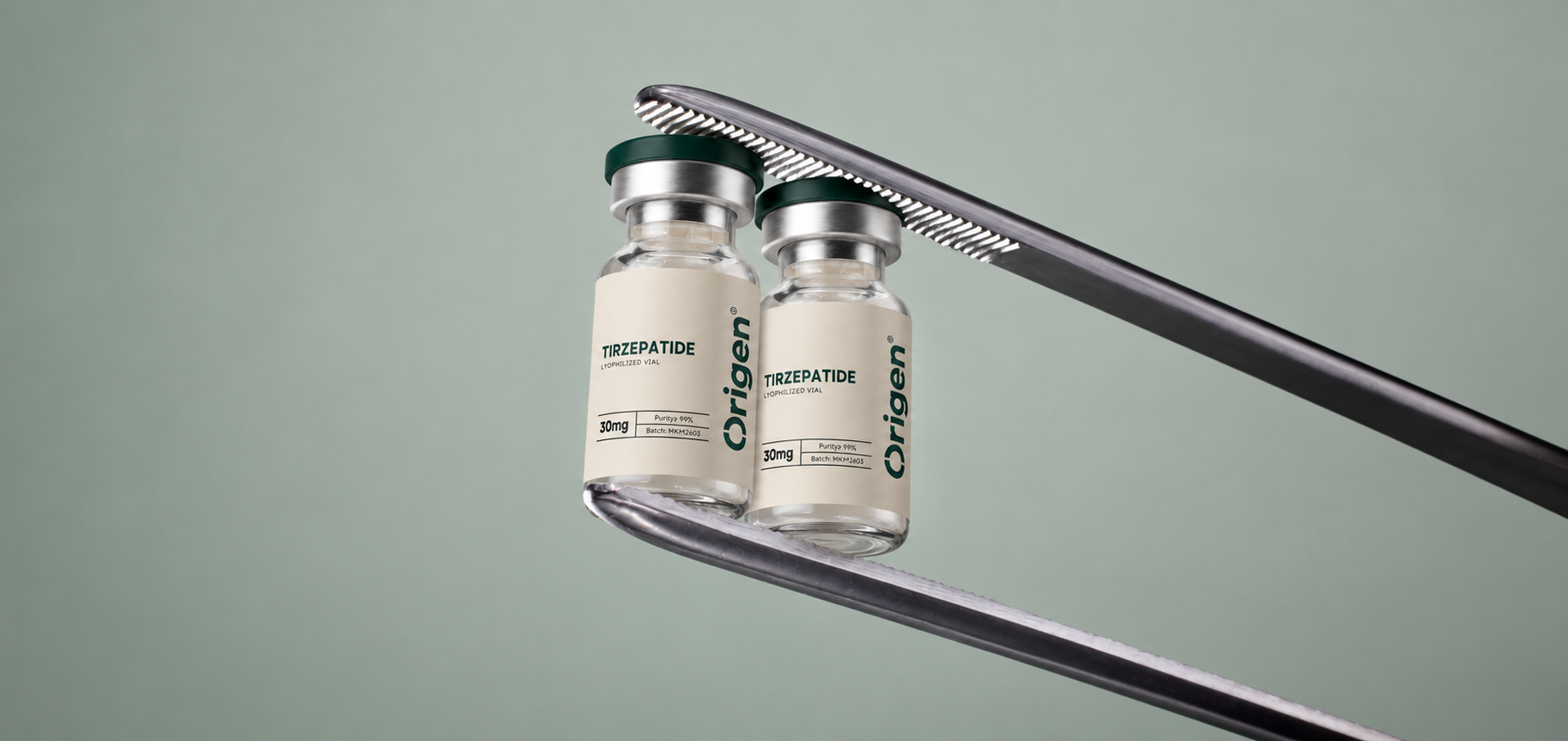
A dual agonist engages two receptors in one molecule. Tirzepatide is the primary example: a single peptide with activity at both the GIP and GLP-1 receptors, first described in 2018. [6]
The published receptor pharmacology shows the two activities are not balanced equally — tirzepatide behaves more like a GIP receptor agonist with additional GLP-1 activity rather than an even split. That imbalance is a design choice, not an accident. [6]
For the compound-level detail, see what tirzepatide is and the mechanism guide.
The mechanism page covers receptor binding and downstream signalling in more depth: how tirzepatide works.
What is a triple agonist?
A triple agonist engages all three receptors. The concept was demonstrated in rodents in 2015 with a designed monomeric triagonist [5], and retatrutide is the clinical-stage example — characterised in 2022 as a glucagon, GIP and GLP-1 receptor agonist. [7]
As with tirzepatide, the three activities are not equal. The published pharmacology describes differing potencies at each receptor, and those ratios are what the molecule is designed around.
For the compound overview, see what retatrutide is.
The mechanism page follows the signalling in detail: how retatrutide works.
Does targeting more receptors automatically mean better results?
No. Receptor count is a description of a molecule, not a measure of its performance.
Several things sit between 'binds three receptors' and 'produces a better outcome':
- Potency and balance. A molecule with three activities can be weak at one of them, or too strong at one of them. The ratio determines behaviour.
- Dose and titration. Trials differ in top dose and in how slowly participants escalate, which changes both effect size and tolerability.
- Population. Effect sizes in people with type 2 diabetes are consistently smaller than in people with obesity and without diabetes — in the same compound class. [12][13]
- Duration. A 48-week result and a 72-week result are not interchangeable.
- Comparator. Placebo-controlled results cannot be read as a comparison against another active compound.
- Safety and tolerability. Adding glucagon agonism adds glucose and heart-rate considerations that a GLP-1-only compound does not carry. [4][7]
- Evidence stage. Phase 2 findings are hypothesis-generating; phase 3 confirms or shrinks them.
The single direct demonstration of this point comes from head-to-head trials. SURPASS-2 compared tirzepatide with semaglutide in type 2 diabetes [9] and SURMOUNT-5 compared tirzepatide with semaglutide in obesity [11]. Those are the sort of randomised comparisons that can support a claim of relative superiority. Counting receptors cannot.
Evidence level: human randomised trials for the comparisons named; mechanistic pharmacology for the receptor descriptions.
Frequently Asked Questions
Is GIP an incretin like GLP-1?
Yes. Both GIP and GLP-1 are incretins — gut hormones released after eating that increase insulin secretion when glucose is elevated. They act on different receptors, and the insulin-releasing effect of GIP is blunted in type 2 diabetes.
Why would a compound activate the glucagon receptor at all?
Because glucagon receptor activation increases energy expenditure and hepatic fat oxidation. The design assumption is that concurrent GLP-1 activity offsets the glucose-raising effect. Whether that balance holds across long trials is a question phase 3 research is meant to answer.
Does a triple agonist beat a dual agonist?
Not established. No published head-to-head trial has reported a comparison of retatrutide with tirzepatide. A comparison trial is registered but has not reported results.