What is tirzepatide?
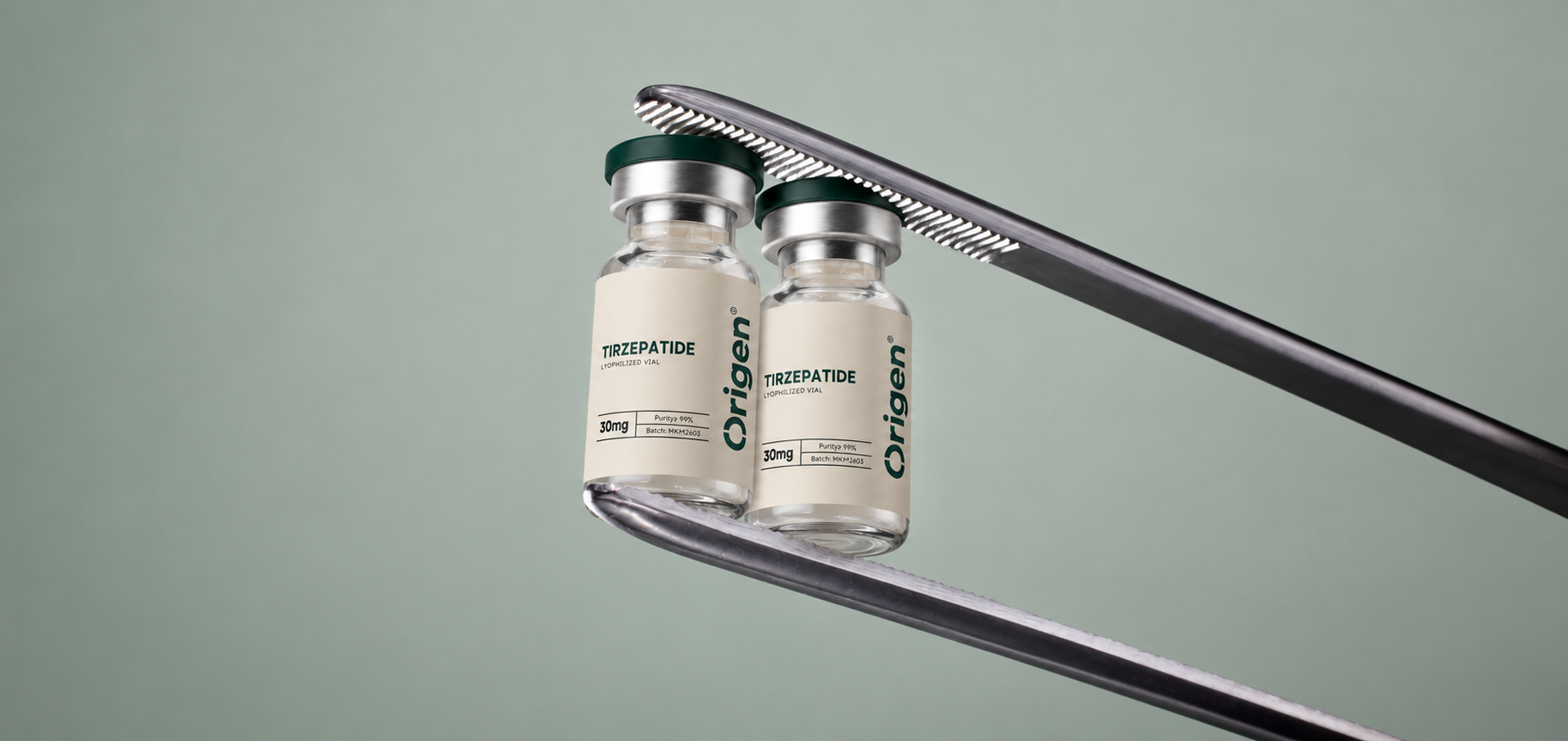
Tirzepatide is a synthetic peptide, a small chain of amino acids built to mimic natural hormone signals, that was designed to switch on two hormone receptors at once. Those receptors are the glucose-dependent insulinotropic polypeptide receptor, usually shortened to GIP receptor, and the glucagon-like peptide-1 (GLP-1) receptor. A receptor agonist is simply a molecule that binds a receptor and activates it, the way a key turns a lock. Because a single molecule turns both locks, tirzepatide is described as a dual GIP and GLP-1 receptor agonist. Its development code was LY3298176. [1]
It helps to step back and ask what a receptor actually is. Cells are covered in proteins that sit in their outer membrane and respond to specific molecules arriving from the bloodstream, somewhat like a mailbox that only accepts one shape of envelope. GIP and GLP-1 are hormones released by the gut after eating; they travel through the blood and land on their matching receptors on cells in the pancreas, brain and elsewhere, where they trigger a cascade of internal changes. A drug built to be a receptor agonist is engineered to fit that same mailbox slot closely enough to trigger the same cascade, often for longer than the natural hormone would, because it is designed to resist the enzymes that normally break the native hormones down within minutes.
Calling tirzepatide simply 'a GLP-1 drug' understates half of what it does. The founding pharmacology paper measured how tightly the molecule binds each receptor, using a laboratory value called Ki, where a lower number means tighter binding. Tirzepatide's GIP receptor Ki was 0.135 nM, comparable to the body's own GIP hormone, against a GLP-1 receptor Ki of 4.23 nM. For comparison, the same study reported semaglutide's GLP-1 receptor Ki as 1.97 nM, meaning tirzepatide binds the GLP-1 receptor less tightly than semaglutide does. [1]
Those binding numbers come from receptor assays in a dish, not from people. They describe how strongly the molecule grips each target under controlled laboratory conditions, which is the starting point for, but not proof of, an effect in the body.
A binding-affinity number like Ki is measured outside a living organism, typically using cells engineered to display large numbers of a single receptor, dosed with the test compound, and then assessed for how much of it stays stuck under standardized conditions. That tells researchers how well the key fits the lock in isolation. It says nothing yet about absorption, how long the molecule survives in blood, how it distributes to different tissues, or what happens when millions of cells across many organs receive the signal at once. Clinical trials exist precisely to answer those further questions, which is why the rest of this article moves from laboratory binding data to trial results measured in actual patients.
How does tirzepatide work?
Both of tirzepatide's target receptors belong to a family called G-protein-coupled receptors, which relay a signal from outside a cell to machinery inside it. In this case, the signalling responds to nutrients: when food raises blood glucose, these receptors are part of how the body senses that and secretes insulin. At the pancreas, this incretin signalling boosts insulin release in a glucose-dependent way, meaning the strength of the response depends on how much glucose is already present rather than firing constantly. GLP-1 receptor signalling is also studied for its effects on gastric emptying, glucagon secretion and appetite, while GIP receptor signalling reaches further, into fat tissue and the brain.
A useful, if imperfect, way to picture this is a molecular switch: the receptor is off until a matching hormone or drug arrives, and once it is flipped, it triggers a fixed set of downstream events inside the cell. Two separate switches, GIP and GLP-1, happen to influence overlapping but not identical parts of digestion, insulin release and appetite, which is why researchers were interested in flipping both at once rather than relying on either alone.
The idea that both receptors were needed, not just one, was tested rather than assumed.
PRECLINICAL
In wild-type mice, dual activation of both receptors produced more weight loss than selective GLP-1 receptor agonists, including semaglutide and liraglutide. When the same experiment was repeated in mice bred to lack one of the receptors, the extra weight loss disappeared. That is the kind of experiment that shows both receptors are actually required for the effect, rather than one receptor doing all the work. [1]
This is what scientists call a knockout experiment: a strain of mice is bred with one specific gene, in this case the gene coding for the GIP or the GLP-1 receptor, deliberately disabled, so those animals cannot make a working copy of that receptor anywhere in their body. Comparing normal ('wild-type') mice against receptor-knockout mice under the identical drug and diet conditions is one of the standard ways biologists distinguish a receptor that is merely present from a receptor that is actually doing the work. If the effect vanishes when a receptor is knocked out, that receptor was necessary for the effect; if the effect were unchanged, it would suggest that receptor was not doing much in that particular pathway.
The receptor biology is unpacked in detail in How does tirzepatide work?.
How do researchers read a clinical trial result?
Before looking at the tirzepatide trial numbers, it helps to understand the structure that produced them, since the same structure recurs throughout this article. A randomised controlled trial assigns participants by chance, rather than by choice, to either the treatment or a comparison group; randomisation is what allows any later difference between the groups to be attributed to the treatment rather than to differences in who happened to volunteer for which group.
'Double-blind' means neither the participants nor the researchers assessing them know who received the active drug and who received the comparator, which prevents expectation or bias from creeping into how symptoms are reported or measured. 'Placebo-controlled' means the comparison group receives an inactive substance rather than nothing at all, so the placebo group's own outcomes reveal how much change happens anyway, from things like attention, lifestyle changes during a study, or the natural course of a condition, independent of any active ingredient.
A trial is also built around a primary endpoint, the single, pre-specified outcome the trial is designed and sized to detect, decided before the trial starts so that researchers cannot simply search through the data afterward for a result to report. For the obesity trial covered below, the primary endpoint was percent change in body weight. A confidence interval, reported alongside many of the results here, is a range calculated from the trial data that is likely to contain the true average effect in the wider population the trial sample was drawn from; a narrower interval reflects a more precise estimate, typically from a larger sample.
Finally, trials proceed in phases. Phase 1 checks safety and dosing in small numbers of people, phase 2 tests a range of doses against a comparator in a larger but still modest group to see which doses are worth pursuing, and phase 3 tests the most promising doses in large populations, often with a comparator, to confirm the effect and characterise its safety before regulators will consider approval. Tirzepatide has published data from all three phases, which is one reason its evidence base is described in this library as unusually complete.
What did the largest obesity trial find?
The short answer: in a 72-week randomised trial, people taking tirzepatide lost substantially more weight, on average, than people taking a placebo, and the effect was larger at higher doses.
HUMAN CLINICAL TRIAL
SURMOUNT-1 enrolled 2,539 adults with a body mass index (BMI) of 30 or above, or 27 or above with at least one weight-related health complication, none of whom had diabetes. Participants were randomly assigned to tirzepatide at 5, 10 or 15 mg once weekly, or to placebo, for 72 weeks. At the start, participants weighed 104.8 kg on average with a mean BMI of 38.0. [3]
The 72-week duration included a 20-week dose-escalation period, during which participants were gradually stepped up toward their assigned target dose rather than starting at full strength immediately. Gradual escalation is a standard design feature for incretin-receptor medicines, used to let the digestive system adjust and to reduce the intensity of early gastrointestinal side effects; it is a trial-design detail rather than a finding about the drug's effectiveness.
| Study design | Detail |
|---|---|
| Registry | NCT04184622 |
| Participants | n = 2,539 |
| Population | BMI ≥30, or ≥27 with a weight-related complication; no diabetes |
| Arms | Tirzepatide 5, 10, 15 mg weekly or placebo, 1:1:1:1 |
| Duration | 72 weeks including 20-week escalation |
| Primary endpoint | Percent change in body weight |
| Endpoint | Result |
| 5 mg | −15.0% (95% CI −15.9 to −14.2) |
| 10 mg | −19.5% (95% CI −20.4 to −18.5) |
| 15 mg | −20.9% (95% CI −21.8 to −19.9) |
| Placebo | −3.1% (95% CI −4.3 to −1.9) |
| ≥5% weight reduction | 85%, 89%, 91% vs 35% placebo |
| ≥20% weight reduction | 50% (10 mg), 57% (15 mg) vs 3% placebo |
| Discontinuation for adverse events | 4.3%, 7.1%, 6.2% vs 2.6% placebo |
A mean change of minus 20.9% is an average across an entire treatment arm, not a guarantee for any one person. The spread behind that average shows up in the threshold rows: 91% of the 15 mg group lost at least 5% of their body weight, but only 57% reached 20% or more. The placebo arm also lost weight on average, 3.1%, which is exactly why a comparison group is needed before crediting any of the result to the drug itself. [3]
It is worth dwelling on why the placebo arm moved at all. Participants in a placebo arm are still examined regularly, often counselled on diet and activity as part of the trial protocol, and know they are being watched, all of which can shift behaviour regardless of the injection they receive. Subtracting the placebo result from the drug result, roughly 17 to 18 percentage points at the higher doses, is a rough way of estimating the portion of the effect attributable to the drug itself rather than to participation in a monitored trial.
The 95% confidence intervals reported alongside each mean give a sense of how precisely that average was measured, given the number of participants in each arm; note that the four intervals shown do not overlap, which is one signal, though not the only one a statistician would look for, that the differences between doses and between drug and placebo are unlikely to be due to chance alone.
- 2,539
- participants
- 72 weeks
- trial duration
- −20.9%
- mean weight change, 15 mg
- −3.1%
- placebo
How does it compare with semaglutide?
Unlike most compound comparisons in this library, this one rests on an actual head-to-head trial rather than two separate studies lined up side by side.
HUMAN CLINICAL TRIAL
SURPASS-2 was an open-label, 40-week phase 3 trial in 1,879 adults with type 2 diabetes. It randomised participants to tirzepatide 5, 10 or 15 mg, or to semaglutide 1 mg, once weekly. At baseline, average blood-sugar control (HbA1c, a marker of average blood glucose over roughly three months) was 8.28%, and average weight was 93.7 kg. [4]
HbA1c measures the fraction of haemoglobin, the oxygen-carrying protein in red blood cells, that has glucose chemically attached to it. Because red blood cells persist for around three months, this single blood test gives a rolling average of blood sugar exposure over that period, rather than a snapshot of glucose at one moment, which is why it is the standard yardstick for judging diabetes treatments over a period of weeks to months rather than day-to-day glucose readings.
'Open-label' means participants and investigators in SURPASS-2 knew which drug each person was taking, unlike the double-blind SURMOUNT-1 trial described above. This is a meaningfully different design: it makes an open-label trial more susceptible to expectation effects on subjectively reported outcomes, though it is a standard and often unavoidable choice when comparing two different injectable devices or dosing schedules that cannot easily be disguised from participants.
| Arm | HbA1c change | Difference vs semaglutide | Weight difference vs semaglutide |
|---|---|---|---|
| Tirzepatide 5 mg | −2.01 points | −0.15 (p=0.02) | −1.9 kg |
| Tirzepatide 10 mg | −2.24 points | −0.39 (p<0.001) | −3.6 kg |
| Tirzepatide 15 mg | −2.30 points | −0.45 (p<0.001) | −5.5 kg |
| Semaglutide 1 mg | −1.86 points | — | — |
The p-values in that table describe how likely it would be to see a difference this large, or larger, purely by chance if there were truly no difference between the drugs. A smaller p-value is stronger evidence against 'no real difference'; by long-standing scientific convention, a value below 0.05 is usually called statistically significant. The 5 mg dose's difference, p=0.02, clears that bar; the 10 mg and 15 mg differences, reported as p<0.001, clear it by a wider margin, meaning those results would be very unlikely to arise from chance alone if the two drugs truly performed the same.
Because this was a direct randomised comparison, it is fair to describe these as real differences between the drugs, not just two separately measured numbers. But the dose matters to how far the finding reaches: semaglutide was tested here at 1 mg, not at the 2.4 mg dose used in obesity trials, so the result speaks to this specific comparison and should not be generalised beyond it. [4]
Side effects affecting the digestive system were broadly similar between the two drugs. Nausea occurred in 17 to 22% of tirzepatide participants versus 18% on semaglutide, diarrhoea in 13 to 16% versus 12%, and vomiting in 6 to 10% versus 8%. Serious adverse events were somewhat more common with tirzepatide, at 5 to 7%, versus 3% with semaglutide. [4]
A serious adverse event, in trial terminology, is not simply an unpleasant symptom; it is a defined category covering outcomes such as hospitalisation, a life-threatening event, or a result requiring significant medical intervention, reported and adjudicated according to strict rules regardless of whether investigators believe it was actually caused by the study drug. That the tirzepatide arms recorded a higher serious adverse event rate does not, by itself, establish that tirzepatide caused each of those events; it is a comparison the published paper reports and that a careful reader should note without over-interpreting.
What did the earlier phase 2 work show?
Before the large phase 3 trials, a smaller phase 2 study tested a range of doses to find out which ones were worth carrying forward.
HUMAN CLINICAL TRIAL
That trial ran for 26 weeks in 318 adults with type 2 diabetes, comparing tirzepatide at 1, 5, 10 and 15 mg weekly against dulaglutide 1.5 mg (another GLP-1 medicine) and placebo, with change in HbA1c as the main outcome measure. [2]
This is the kind of dose-ranging study that sits between a small first-in-human phase 1 trial and a large confirmatory phase 3 programme. Its job is not to prove a medicine works beyond doubt, since 318 participants is a comparatively modest sample for that purpose, but to narrow down which of several candidate doses are effective enough and tolerable enough to justify testing in the much larger, more expensive phase 3 trials that follow.
Per-arm numeric results from that paper are not reproduced here because the full text could not be verified against a primary source during preparation. The trial design and comparators above are taken from the registry and the published record.
The main significance of this trial is structural rather than numerical: it established the dose range and comparator design that the later phase 3 SURPASS and SURMOUNT programmes then tested at a much larger scale. [2][3][4]
What is tirzepatide approved for?
Tirzepatide is a licensed medicine, not an experimental compound. The FDA approved it as Mounjaro for type 2 diabetes on 13 May 2022, and as Zepbound for chronic weight management on 8 November 2023.
Regulatory approval of this kind follows the completed phase 3 evidence described above: an agency such as the FDA reviews the full trial data, including the safety findings and adverse event rates, and issues an approval that specifies precisely which condition and population the medicine may be marketed for. Mounjaro and Zepbound are the same molecule, tirzepatide, approved under two separate brand names because the two approvals covered two different intended uses, evaluated against two different sets of trial evidence.
That distinction matters for how this page should be read. Origen supplies research materials for laboratory use, and nothing here describes a use, a dose, or an outcome for a person. The trials summarised above describe a pharmaceutical product administered under clinical supervision, with medical monitoring and predefined endpoints, which is a different context from a research material handled in a lab.
For a side-by-side reading against the investigational triple agonist, see Tirzepatide versus retatrutide.
Frequently Asked Questions
Is tirzepatide a GLP-1 drug?
Only in part. It binds the GIP receptor more tightly (Ki 0.135 nM) than the GLP-1 receptor (Ki 4.23 nM).
How much weight was lost in SURMOUNT-1?
Mean changes of −15.0%, −19.5% and −20.9% at 5, 10 and 15 mg versus −3.1% with placebo over 72 weeks.
Did tirzepatide beat semaglutide?
In SURPASS-2, a direct 40-week comparison, all three doses lowered HbA1c more than semaglutide 1 mg, with differences of 0.15 to 0.45 points.
How many people stopped because of side effects?
4.3%, 7.1% and 6.2% across the three doses in SURMOUNT-1, against 2.6% on placebo.