What is the difference between GHK and GHK-Cu?
The short answer: GHK-Cu is GHK with copper attached. The longer answer is that copper binding is not a cosmetic addition. It changes the species present in solution, and the studies that measured biological effects nearly always specified which species they were adding to the culture.
Evidence level: coordination chemistry (physical measurement), in vitro cell biology, and animal wound models. No human clinical trial with a validated efficacy endpoint is cited here, because none is established in the indexed literature.
What is GHK?
GHK is a tripeptide: glycine, L-histidine, L-lysine. It was identified in human plasma in work published from the late 1970s onward, and the same group reported that its growth-modulating activity in plasma was associated with copper. [1]
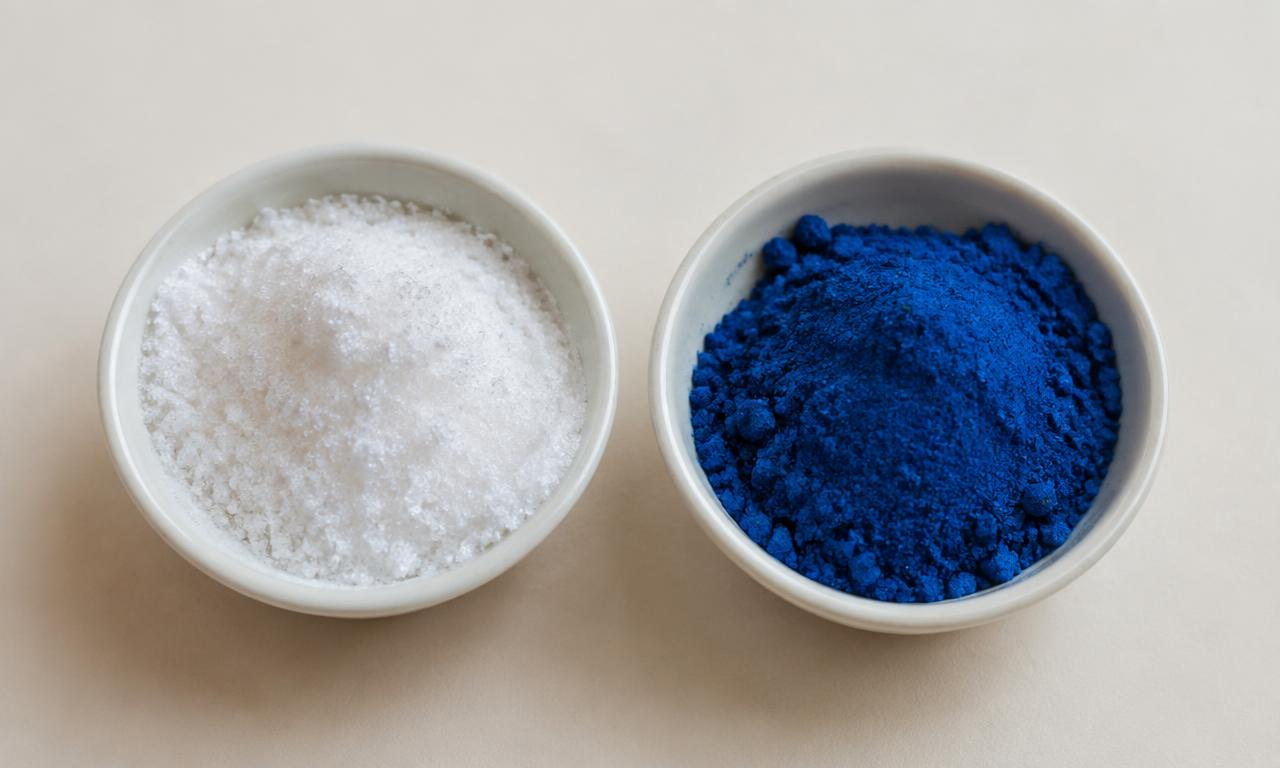
As a free peptide, GHK is a small, water-soluble molecule with no colour. The histidine imidazole ring and the free amino terminus are what make it an effective copper ligand — this is ordinary coordination chemistry, not a special property.
How does GHK bind copper?
The binding was characterised directly. Lau and Sarkar examined the interaction of copper(II) with GHK and described the complex that forms under physiological conditions. [3]
Freedman and colleagues then used optical, electron paramagnetic resonance and electron spin-echo spectroscopy to determine the structure in solution. At neutral pH, GHK forms a mononuclear 1:1 copper(II) compound, with copper equatorially coordinated by two or three nitrogen atoms, one of which is in the histidyl imidazole ring. [4]
That paper reported something else worth repeating: the polymeric, oxygen-bridged structure determined by X-ray crystallography in the solid state does not exist in solution. [4] The picture of GHK-Cu that is accurate depends on whether you are describing a crystal or a solution.
Evidence level: analytical and physical chemistry. These are measurements of molecular structure, not of biological outcome.
What changes when copper is bound?
Chemically, a great deal: the complex is a different species with a different charge state, a characteristic blue colour, and different stability and transport behaviour from the free peptide.
Biologically, the honest answer is narrower. The early hypothesis was that GHK functions by facilitating copper uptake into cells [2], and much of the subsequent cell work used the complex specifically. But 'the complex is chemically distinct' and 'the complex is biologically superior' are different statements, and the second is not established by chemistry alone.
A reader should also keep the copper itself in view. When a study reports an effect of GHK-Cu, the effect may be attributable to the peptide, to the delivered copper, or to the complex as a unit. Few of the classic studies were designed to separate those possibilities.
Which form was used in the major research studies?
This is the practically useful section. The table below names the species each study specified.
| Study | Model | Form used | What was measured |
|---|---|---|---|
| Maquart 1988 [5] | Fibroblast culture | GHK-Cu (copper complex) | Collagen synthesis |
| Wegrowski 1992 [6] | Fibroblast culture | GHK-Cu (copper complex) | Sulfated glycosaminoglycan synthesis |
| Maquart 1993 [7] | Rat experimental wounds | GHK-Cu (copper complex) | Connective tissue accumulation in vivo |
| Pyo 2007 [10] | Human hair follicle, in vitro | Tripeptide–copper complex | Hair follicle growth parameters |
| Campbell 2012 [8] | Human lung fibroblasts / gene signature | GHK (free tripeptide) | Reversal of an emphysema-associated gene expression signature |
The pattern is clear: the dermatology and wound-healing literature is predominantly GHK-Cu, while the 2012 gene-signature work that is often cited in copper-peptide marketing used free GHK. [8] Those are not the same molecule and should not be pooled into one evidence claim.
Why does this distinction matter when reading research?
Because a citation is a claim about what was demonstrated. If a page states that GHK-Cu reverses a lung gene signature, and the underlying study used free GHK, the citation does not support the sentence.
- Check the methods section, not the abstract. The species used is usually specified where the treatment is described.
- Watch for 'copper peptide' as a loose umbrella term. It can refer to GHK-Cu, to other copper-binding peptides, or to a cosmetic formulation of uncertain composition.
- Note the concentration. GHK-Cu effects in culture are typically reported at very low concentrations and are not linear with dose.
- Note the model. Fibroblast culture, rat wound and human follicle organ culture answer different questions, and none of them is a clinical trial.
Origen does not restate the widely circulated claims about GHK that could not be traced to a primary source — including an often-quoted count of clinical trials and figures for age-related decline in plasma GHK. They are excluded until a verifiable source supports the exact claim.
What evidence exists for GHK-Cu?
Rather than duplicating it here, the evidence is set out compound by compound across the GHK-Cu cluster.
Start with the overview: what GHK-Cu is.
The chain from copper chemistry to cell signalling is followed in the GHK-Cu mechanism guide.
Collagen endpoints specifically are covered in GHK-Cu collagen research.
For dermal endpoints, see GHK-Cu skin research.
For follicle work, see GHK-Cu hair research.
Frequently Asked Questions
Is GHK-Cu just GHK with copper added?
Chemically, yes — a 1:1 copper(II) complex of the tripeptide. But the complex is a distinct species with its own solution structure, so studies of one do not automatically describe the other.
Which form do most studies use?
The fibroblast, wound-healing and hair-follicle literature predominantly used the copper complex. The 2012 lung gene-expression study used free GHK.
Does copper binding make GHK more effective?
Not established by the chemistry alone. Most biological work used the complex, so there is little matched comparison of the two forms in the same model.