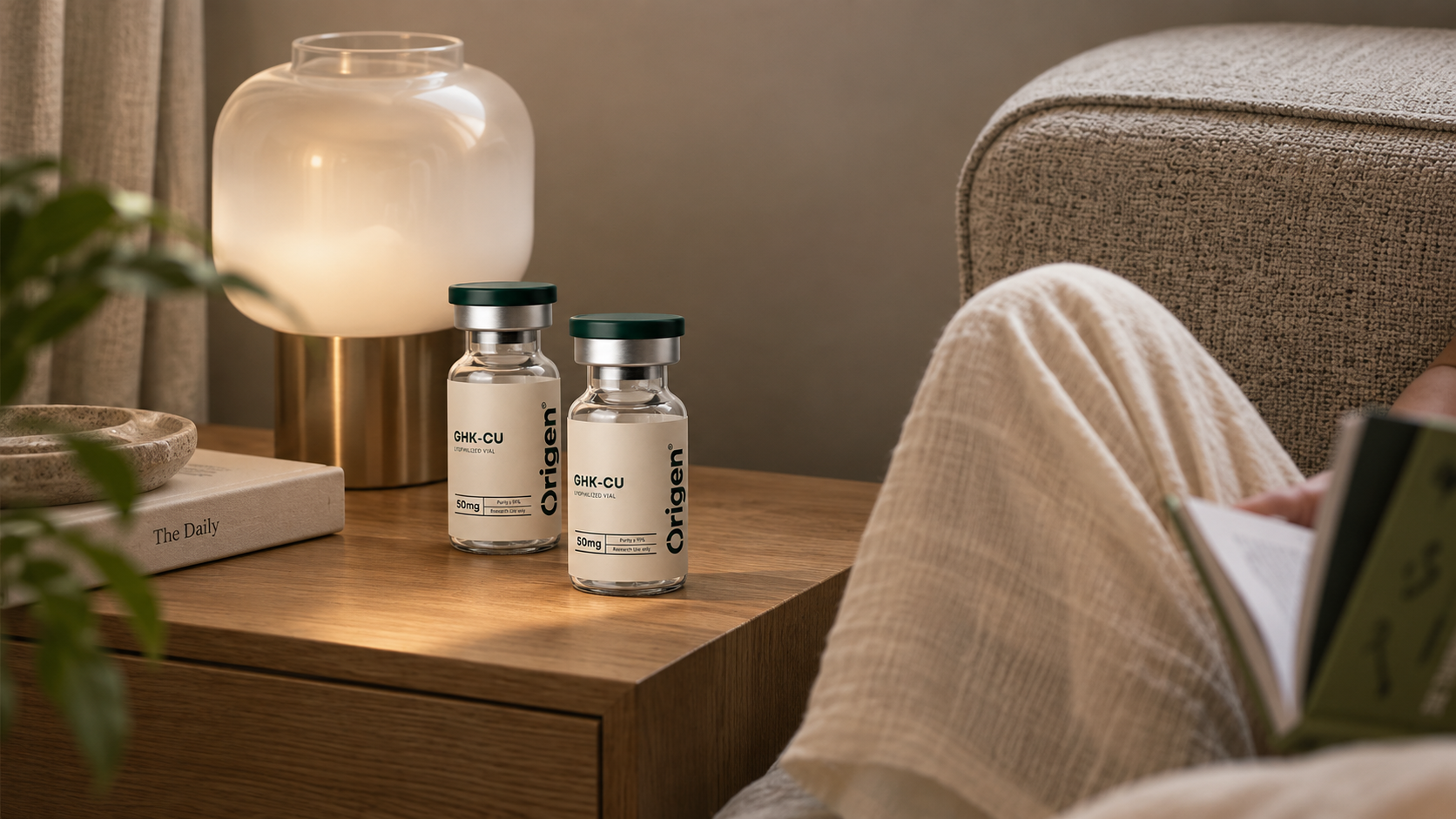
What is GHK-Cu?
GHK-Cu is a complex formed when a small chain of three amino acids, glycine, histidine, and lysine, binds to a copper ion. This three-amino-acid chain is called a tripeptide, and the resulting copper complex is what researchers mean by GHK-Cu. The peptide itself occurs naturally in human blood plasma, and its histidine and lysine components grip copper tightly, which is why the complex forms easily and why solutions of it look distinctly blue. [1]
The word tripeptide simply describes size: amino acids are the building blocks of proteins, and when only three are joined end to end by chemical links called peptide bonds, the result is short enough to be called a peptide rather than a protein. A tripeptide is small enough to diffuse relatively freely in solution, which is part of why it is easy to study in a dish, and also part of why, in a living body, it is broken down and cleared quickly rather than persisting.
The copper part of the name refers to how the peptide holds onto a copper ion, a positively charged copper atom, rather than to a permanent chemical bond of the kind that joins the amino acids to each other. Histidine's ring-shaped side chain and the free amine group on the peptide's end can each offer up a pair of electrons to the copper ion, forming what chemists call a coordination complex. That kind of bond is real but reversible: the same copper can, in principle, be picked up and later released, which is one reason researchers are interested in GHK-Cu as a copper carrier as well as a signalling molecule in its own right.
Almost every claim circulating about GHK-Cu traces back to a body of cell-culture research that began in the 1980s, plus one large narrative review, meaning a paper that summarises existing studies rather than reporting new experiments, published in 2018. [1] That distinction matters more for this compound than for almost any other peptide in this library, because far more has been written about GHK-Cu than has actually been measured in people.
REVIEW
Evidence level for GHK-Cu is predominantly in vitro, meaning experiments done in cells grown in a dish rather than in a living organism. Where a finding below comes from cell culture, organ culture (small pieces of living tissue kept alive outside the body), or a review rather than a clinical trial, it is labelled as such.
It is worth being explicit about what an in vitro result cannot show. A dish of cells has no blood supply, no immune system, no skin barrier to cross, and no other organs competing for the same molecule or breaking it down over time. It also typically exposes cells to a single, unchanging concentration for a fixed period, which is nothing like the rise and fall of a substance applied to skin or injected into tissue. None of that makes in vitro work worthless: it is usually the first and cleanest way to ask whether a molecule can do something at all, before anyone tests whether it does that same thing inside a whole, living organism.
The practical takeaway: GHK-Cu has a well-mapped biochemistry and a poorly mapped clinical profile. A compound can behave in an interesting way at the laboratory bench and still lack the randomised human evidence needed to support a claim about what it does for a person.
How does GHK-Cu behave in laboratory models?
The most-cited primary finding comes from a 1988 study using cultured human skin fibroblasts, the cells in skin's deeper layer responsible for producing collagen. Fibroblasts are the resident construction cells of connective tissue: their job is to synthesise and maintain collagen and other structural proteins that give skin its scaffolding, so an experiment about collagen output naturally uses them rather than, say, skin's outer surface cells. Collagen synthesis rose as the concentration increased, starting at roughly 10⁻¹² to 10⁻¹¹ molar (a unit of concentration; smaller exponents mean a more dilute solution) and reaching its highest point at 10⁻⁹ M. The authors reported this rise happened without an increase in the number of cells, meaning each cell was producing more collagen rather than the dish simply containing more cells. [2]
A collagen synthesis assay, the kind of test used here, typically works by adding a labelled or measurable building block to the culture medium and then tracking how much of it gets incorporated into newly made collagen protein over a set period. That tells researchers about production, not about how that collagen would ultimately organise itself into the structured fibre network that gives skin its firmness, since a dish of fibroblasts never builds anything resembling actual skin architecture.
IN VITRO
| Study design | Detail |
|---|---|
| Model | Cultured human skin fibroblasts |
| Design | Concentration-response, cell culture |
| Intervention | GHK-Cu complex |
| Concentrations | 10⁻¹² M to 10⁻⁹ M |
| Endpoint | Collagen synthesis |
| Human data | None |
| Endpoint | Result |
| Threshold effect | Observed from 10⁻¹²–10⁻¹¹ M |
| Maximal effect | 10⁻⁹ M |
| Effect independent of cell count | Yes, as reported by the authors |
The published abstract describes the shape of the concentration-response curve rather than a single percentage increase, so no percentage figure is quoted here. If you see a specific percentage attributed to this study elsewhere, it is worth checking whether that number actually appears in the paper.
What this snapshot does show is that isolated human fibroblasts can respond to GHK-Cu by making more collagen, and that the response has a defined concentration window rather than simply increasing forever. What it does not show is anything about skin as an organ: no barrier was crossed, no blood vessel delivered the compound, and no visible change in tissue thickness, firmness, or appearance was measured, because none of those things exist in a dish of individual cells.
A separate study, also done without blood serum in the culture (a condition called serum-free that removes a source of natural growth factors), compared copper tripeptide with tretinoin, a vitamin-A-derived acne and anti-ageing ingredient, and measured the release of two signalling proteins, basic fibroblast growth factor and transforming growth factor-beta 1, from cells derived from normal and scar-forming (keloid) tissue. [3] This, too, is a cell-culture experiment: it describes signalling behaviour in a dish, not a treatment outcome in a person.
Growth factors like these two are proteins that cells release to communicate with their neighbours, essentially instructing nearby cells to divide, migrate, or change their behaviour. Measuring how much of them a cell releases under a given exposure is a common way to probe a compound's biological activity before anyone attempts a full tissue or clinical study, but it is one step removed even from the collagen-synthesis result above: it shows a signal was sent, not that a downstream tissue-level effect followed.
What is the difference between cell culture, organ culture, and a living body, and why does it matter here?
Three different kinds of laboratory model appear across the GHK-Cu literature, and they sit at different distances from real human biology. The fibroblast studies above use cell culture: individual cells, of a single type, grown as a thin layer on the bottom of a plastic dish and bathed in a nutrient liquid. This is the simplest and most controlled model, which is exactly why it is used first, but it strips away everything that makes tissue behave like tissue, including the physical structure that holds different cell types together and lets them signal to each other in three dimensions.
Organ culture, used in the hair follicle research discussed later in this library, is one step closer to the body: a small, intact piece of living tissue, such as a follicle, is kept alive and functioning outside the body for a period of days. It keeps the natural architecture and mix of cell types in place, so it can show things a single-cell-type dish cannot, such as how a whole follicle elongates. It still has no blood supply, no immune system, and no hormonal environment, and it can only be kept alive for a limited time before it degrades.
A living organism, human or animal, is the only model that includes circulation, immune surveillance, a skin or gut barrier controlling what gets in, and organs that metabolise and clear a compound over time. None of the primary GHK-Cu studies referenced in this library were conducted in that setting in humans. Understanding this ladder, cell culture, then organ culture, then whole animal, then human, is the single most useful tool for reading any claim about this peptide, because a finding at one rung does not automatically hold at the next.
Why do the concentrations in these studies matter?
The active range in the fibroblast work is around a billionth of a mole per litre, an extremely dilute solution. Cell-culture concentration is a controlled variable, meaning the researcher decides exactly what the cells are exposed to and for how long, with nothing else changing.
In intact tissue that control disappears. What actually reaches a given layer of skin depends on the delivery vehicle, how well the skin barrier is penetrated, how much of the compound binds to other molecules, and how quickly it is cleared away, none of which the culture model measures. This is why a strong concentration-response curve in a dish cannot be translated into a recommended applied amount, and why laboratory findings are better described as hypothesis-generating than dose-defining.
The hair-follicle work makes this point sharply. In that study, the response reversed at higher concentrations: follicle growth was inhibited rather than increased once the concentration rose above the effective window. [4] In plain terms, more was not better — it was worse. This pattern, where an effect appears at low doses and reverses at higher ones, is called biphasic.
Biphasic dose response is worth understanding in its own right, because intuition usually assumes a straight line: a little does a little, more does more. Many biological systems do not behave that way. A molecule can occupy a receptor or trigger a signalling pathway usefully at a low concentration, then, at a higher concentration, overwhelm that same pathway, trigger a second and opposing pathway, or become directly toxic to the cell. The result, plotted on a graph, looks like a hill rather than a ramp: effect rises, peaks, and falls again as concentration keeps climbing. That shape is exactly what the follicle data below describe, and it is the reason a compound cannot simply be assumed safe or effective at whatever concentration a product happens to use.
What human evidence exists for GHK-Cu?
Very little that can be verified as peer-reviewed primary research with reported numbers. The cosmetic studies most often cited online include a book chapter in a cosmeceuticals textbook and manufacturer-associated reports rather than indexed clinical trials, and their sample sizes, durations, and effect sizes cannot be confirmed against a primary source.
HUMAN
One small pilot study, an early, exploratory study usually done to check feasibility rather than to prove an effect, compared topical creams including a copper-binding peptide against tretinoin on normal (not sun-damaged) skin. It looked at tissue structure under a microscope rather than measuring a clinical outcome like wrinkle depth, and its authors describe it explicitly as a pilot comparison, not an efficacy trial.
REVIEW
The 2018 review is the most comprehensive single document on the compound, and it is also the source of much of the broad language now in circulation. Its author has a long-standing commercial interest in GHK-Cu cosmetic formulations, and it summarises existing cell and animal work rather than presenting new primary data. [1] That does not make it wrong; it makes checking the original studies it cites more important, not less.
A review article, in general, is not a new experiment. It is a document in which an author reads and organises existing published studies, often adding interpretation, context, and a broader narrative than any single paper offers on its own. Reviews are genuinely useful for orientation and for spotting patterns across many small studies, but they inherit the strengths and weaknesses of whatever they cite, and they add another layer, the author's own framing and emphasis, on top. Two facts about a review are always worth checking before treating it as evidence: whether it is presenting new data or repackaging old data, and whether its author has a financial or professional stake in the substance being reviewed. Both apply here, which is why this guide treats the 2018 review as a map of the literature rather than as a source of new proof.
- 1988
- first fibroblast collagen study
- 10⁻⁹ M
- peak concentration in that model
- 12 days
- longest cited follicle organ culture
- 0
- verified randomised human outcome trials
How does the skin evidence differ from the hair evidence?
| Question | Skin research | Hair research |
|---|---|---|
| Strongest model | Cultured human fibroblasts [2][3] | Ex vivo human follicle organ culture [4] |
| Typical endpoint | Collagen synthesis, growth-factor secretion | Follicle elongation, dermal papilla cell proliferation |
| Human clinical trials | Pilot and non-indexed reports only | None verified |
| Direction of effect at high concentration | Not characterised in cited work | Reversed — elongation inhibited [4] |
The most cited hair study tested AHK-Cu, an alanine-containing variant of the peptide, not GHK-Cu itself. Sources that present it as GHK-Cu hair evidence are substituting one compound for another. [4]
The skin work and the hair work sit at different rungs of the evidence ladder described above. The skin data come entirely from flat, single-cell-type cultures, the simplest model. The hair data come from organ culture, a model that keeps a small piece of real tissue intact and is generally considered more informative about whole-tissue behaviour, but which used a different molecule and still stopped well short of testing a living person.
The two areas are covered separately in GHK-Cu and skin research and in the hair article below.
How should claims about GHK-Cu be read?
Three questions resolve most of the confusion. Which model produced the finding: cells in a dish, tissue kept alive outside the body, animals, or people? Which exact compound was tested, GHK-Cu or a variant such as AHK-Cu? And does the source report an actual number, or only that an effect occurred?
Applied consistently, those questions rule out most of the strong claims made about this peptide while leaving the genuine biochemistry intact. GHK-Cu has reproducible effects on fibroblast behaviour in culture. It does not have a randomised human evidence base for a cosmetic or regenerative outcome, and no benefit to human skin or hair is established.
A useful, if imperfect, analogy: a promising result in a fibroblast dish is a bit like a strong signal picked up in a single, well-controlled laboratory test tube experiment for a new material, long before that material is ever built into a working bridge. The chemistry can be entirely real and still be several engineering steps away from the finished structure it is being discussed as if it already were.
For the follicle-level detail, continue to GHK-Cu and hair research.
Frequently Asked Questions
Is GHK-Cu proven to rebuild collagen in human skin?
No. Increased collagen synthesis has been measured in cultured human fibroblasts, not in a randomised human trial with a clinical endpoint.
Why is GHK-Cu blue?
The blue colour comes from the copper(II) ion coordinated by the peptide's histidine and lysine residues.
Is more GHK-Cu better?
The follicle organ-culture data show the opposite above the active window, where elongation was inhibited rather than increased.
Why is the 2018 review treated cautiously here?
It is a narrative review rather than primary data, and its author has a commercial interest in GHK-Cu formulations.