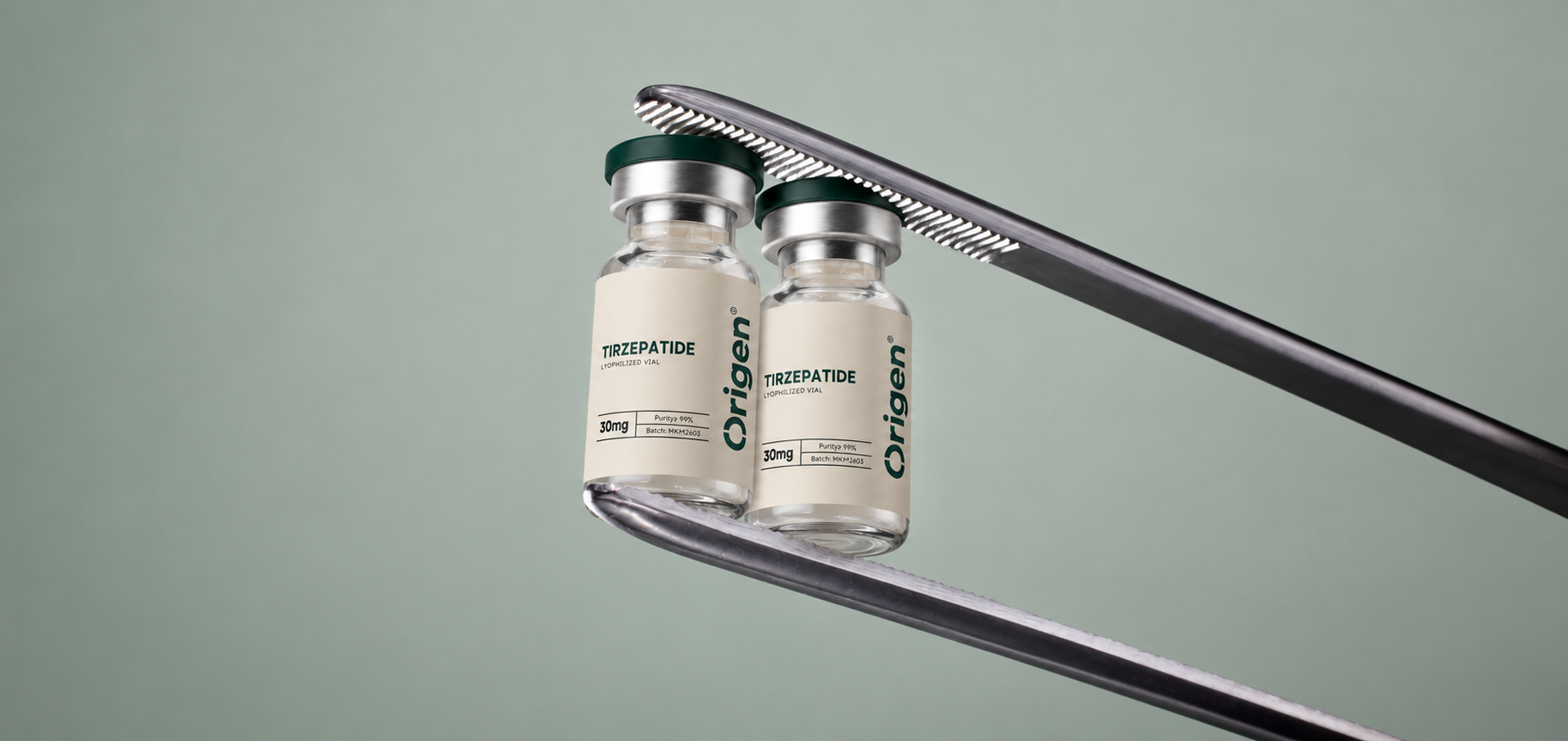
What are CJC-1295 and ipamorelin?
CJC-1295 is a synthetic analog of growth-hormone-releasing hormone. Ipamorelin is a pentapeptide that acts at the ghrelin receptor, also called the growth-hormone secretagogue receptor. Both were developed to increase growth-hormone secretion, but they do it through different upstream inputs, which is the whole reason they are discussed together.
Growth-hormone-releasing hormone is the natural signal the hypothalamus sends to the pituitary gland to tell it to release growth hormone. An “analog” is a laboratory-built molecule engineered to resemble that natural signal closely enough to bind the same receptor and trigger the same release. A “secretagogue” is simply any substance that causes a gland to secrete something — in this case, growth hormone from the pituitary. Ipamorelin is a secretagogue that works through a second, separate door into the same room: the ghrelin receptor, named for the hormone ghrelin, which is better known for its role in hunger but which also carries a growth-hormone-releasing signal.
Because CJC-1295 and ipamorelin approach the pituitary through two different receptors, their effects are often described as complementary rather than duplicate. That is a mechanistic observation about receptor biology, not a claim about what happens when the two are combined in a person — a distinction this article returns to below.
The naming is where most confusion starts. CJC-1295 exists in two distinct molecular forms: one carrying a Drug Affinity Complex, abbreviated DAC, which binds albumin and greatly extends how long the molecule persists, and one without it. Albumin is the most abundant protein circulating in blood; anything chemically tethered to it is cleared out of the body far more slowly than it would be on its own, because the body treats albumin itself as long-lived. Every published human trial of CJC-1295 used the DAC form. [1][2]
Evidence levels differ sharply across this pairing. CJC-1295 with DAC has published human pharmacodynamic trials. Ipamorelin has detailed animal and cell pharmacology plus one human phase 2 trial that did not meet its primary endpoint. The combination has no published clinical trial at all.
Keeping the two compounds and the two CJC forms separate is not pedantry. It is the difference between describing what has been measured and repeating claims that no study supports.
How does the growth-hormone axis actually work?
Growth hormone is not released as a steady drip. The pituitary gland fires it off in short bursts, or pulses, typically a handful of times over 24 hours, mostly overnight, with very little in between. This on-off rhythm, called pulsatile secretion, is thought to matter for how downstream tissues respond, which is why researchers checking a new growth-hormone stimulant look not just at how much hormone rises but at whether the natural pulse pattern survives.
Growth hormone itself has a short life in the bloodstream, so researchers rarely measure it as the main sign that something worked over time. Instead they track insulin-like growth factor 1, or IGF-I, a second hormone that the liver produces in response to growth-hormone signalling. IGF-I is more stable from hour to hour, so a sustained rise in IGF-I is generally read as evidence that growth-hormone signalling has been elevated over a period of days, not just at the moment of a single pulse. Both of the concepts above — pulsatility and IGF-I as a marker — recur throughout the human CJC-1295 data below.
Pharmacokinetics is the branch of pharmacology that measures how a substance moves through the body over time: how quickly it appears, how it is distributed, and above all how quickly it is cleared. The single most-quoted pharmacokinetic figure for a compound is its half-life — the time it takes for the concentration in blood to fall by half. A short half-life means a drug must be dosed frequently to keep any effect going; a long half-life, like the one produced by attaching DAC to CJC-1295, means a single dose keeps acting for days.
What did the human CJC-1295 trials measure?
Two randomised, placebo-controlled, double-blind ascending-dose studies in healthy adults aged 21 to 61 tested CJC-1295 with DAC over 28 and 49 days. An ascending-dose study is a design in which successive small groups of participants receive progressively higher amounts of a compound, starting from a very cautious dose, so that researchers can watch for problems before going higher — it is standard early-stage practice, aimed at pharmacokinetics and safety rather than proving a clinical benefit. The reported terminal half-life was 5.8 to 8.1 days. A single subcutaneous dose raised growth hormone by two- to ten-fold for at least six days and IGF-I by 1.5- to three-fold for nine to eleven days. With repeated weekly or biweekly doses, mean IGF-I remained above baseline for up to 28 days. Tolerability was best at 30 and 60 micrograms per kilogram, and no serious adverse reactions were reported. [1]
HUMAN CLINICAL TRIAL
| Study design | Detail |
|---|---|
| Compound | CJC-1295 with DAC |
| Design | Two randomised, double-blind, placebo-controlled ascending-dose trials |
| Population | Healthy adults, 21–61 years |
| Duration | 28 days and 49 days |
| Dosing | Single ascending doses; 2–3 weekly or biweekly doses |
| Endpoints | GH and IGF-I concentrations, safety, half-life |
| Endpoint | Result |
| Half-life | 5.8–8.1 days |
| GH increase | 2- to 10-fold, sustained at least 6 days |
| IGF-I increase | 1.5- to 3-fold, sustained 9–11 days |
| Best tolerated doses | 30 and 60 µg/kg |
| Serious adverse reactions | None reported |
In plain terms, this trial shows that a single injection of CJC-1295 with DAC can keep growth hormone and IGF-I elevated for the better part of a week to two weeks, and that repeated dosing can hold IGF-I above its starting point for roughly a month. It does not show what that sustained elevation does to muscle, fat, sleep, or any other downstream outcome — those endpoints were not measured here. It is a hormone-concentration and safety study, not an effectiveness study.
A second study asked whether pulsatile growth-hormone release survives continuous stimulation. In healthy men aged 20 to 40 given a single 60 or 90 microgram per kilogram injection, pulse frequency and pulse magnitude were unchanged one week later, while trough growth hormone rose 7.5-fold (p<0.0001), mean growth-hormone secretion rose 46% (p<0.01) and IGF-I rose 45% (p<0.001). The two doses did not differ significantly, and the IGF-I rise did not correlate with growth-hormone pulse parameters, leading the authors to attribute it to the higher trough rather than to larger pulses. [2]
The “trough” is the low point of hormone concentration between pulses. Finding that the trough rose while the pulses themselves stayed the same size and frequency is the key result: it suggests the drug is topping up the background level of growth hormone without overriding the body’s own bursting rhythm. That distinction is why researchers describe this as preserving pulsatility rather than replacing it with a flat, continuous signal, which is the pattern generally considered less physiological.
What does the ipamorelin research show?
The founding 1998 paper is a laboratory and animal study, not a human one. In rat pituitary cell culture ipamorelin released growth hormone with an EC50 of 1.3 plus or minus 0.4 nmol per litre. EC50 is the concentration of a substance needed to produce half of its maximum possible effect in that system — a standard potency measure, and a lower EC50 generally means a substance is effective at a smaller amount. In anaesthetised rats the ED50, the equivalent measure for a dose given to a whole animal, was 80 plus or minus 42 nmol per kilogram, and in conscious swine 2.3 plus or minus 0.03 nmol per kilogram.
Its distinguishing property was selectivity: in swine it did not raise ACTH or cortisol above growth-hormone-releasing-hormone control levels even at more than 200 times the ED50 for growth-hormone release, unlike the older secretagogues GHRP-6 and GHRP-2, and it did not affect FSH, LH, prolactin or TSH. ACTH and cortisol are stress-hormone signals, and FSH, LH, prolactin and TSH regulate reproduction, lactation and thyroid function; a secretagogue that leaves all of them alone while still releasing growth hormone is described as selective, meaning it appears to act narrowly on the intended pathway rather than broadly across the hormonal system. That selectivity is a laboratory and animal finding, not something confirmed with the same rigor in humans. [3]
ANIMAL STUDY
| Study design | Detail |
|---|---|
| Models | Rat pituitary cells, anaesthetised rats, conscious swine |
| Comparators | GHRP-6, GHRP-2, GHRH |
| Endpoints | GH release, ACTH, cortisol, FSH, LH, prolactin, TSH |
| Human data | None in this paper |
| Endpoint | Result |
| Rat pituitary cell EC50 | 1.3 ± 0.4 nmol/L |
| Anaesthetised rat ED50 | 80 ± 42 nmol/kg |
| Conscious swine ED50 | 2.3 ± 0.03 nmol/kg |
| ACTH and cortisol | Not raised above control at >200× the GH ED50 |
What this paper shows is a well-characterised receptor pharmacology in two animal species and isolated cells: ipamorelin turns on growth-hormone release without obviously turning on several other hormonal systems at the same time. What it cannot show, because it was not designed to, is whether that same selectivity and potency hold in a human body, or what it would mean for any human outcome over weeks or months.
HUMAN CLINICAL TRIAL
Ipamorelin was later taken into human testing for a clinical indication, and that trial is the part most often left out. A multicentre, double-blind, placebo-controlled phase 2 study in adults undergoing bowel resection enrolled 117 participants, with 114 analysed, and gave intravenous ipamorelin at 0.03 mg/kg twice daily. Median time to tolerating a standardised solid meal was 25.3 hours with ipamorelin against 32.6 hours with placebo, p=0.15, which is not statistically significant. No key secondary endpoint reached significance either. The compound was well tolerated, with treatment-emergent adverse events in 87.5% of the ipamorelin group and 94.8% of the placebo group. [4]
The primary endpoint of a trial is the single outcome it is designed and statistically powered to answer; everything else is secondary. A p-value of 0.15 means that, if ipamorelin genuinely had no effect on recovery time in this population, a difference this size or larger would still be expected to occur by chance about 15% of the time — well above the conventional 5% threshold used to call a result statistically significant. In plain language: the numeric difference favoured ipamorelin, but the trial cannot rule out that it was due to chance, and the pre-specified secondary measures did not reach significance either. That is what “missed its primary endpoint” means here, and it is a materially different statement from “ipamorelin does not work” or “ipamorelin failed safety testing.” The compound was well tolerated; it simply did not demonstrate the clinical benefit the trial was designed to detect, in this specific postoperative setting.
This is a null result in the only published human efficacy trial of ipamorelin, in a surgical recovery indication rather than a body-composition one. It does not disprove the pharmacology, and it should not be omitted when summarising the evidence.
Has the combination itself been studied?
No published human clinical trial of CJC-1295 combined with ipamorelin could be located in the indexed literature. Nor is there a published human trial of CJC-1295 without DAC. Those are two separate evidence gaps, and both sit directly underneath the most common way these compounds are described.
It is worth being precise about what “no published human trial” does and does not mean. It does not mean the combination has been tried and shown not to work — that would require a study that was run and reported. It does not mean regulators have reviewed and rejected it. It means, specifically, that no controlled study measuring the combination’s effects in people exists in the searchable scientific record, so any number attached to it — a ratio, a response rate, a timeline — has no study behind it and cannot be verified or falsified by inspecting the evidence.
- 2
- human CJC-1295 trials, DAC form only
- 1
- human ipamorelin efficacy trial, null result
- 0
- published trials of CJC-1295 without DAC
- 0
- published trials of the combination
The mechanistic rationale for pairing them is real: growth-hormone-releasing-hormone receptor signalling and ghrelin receptor signalling are distinct inputs converging on the same secretory axis, so combining them is a sensible experiment to run. Plausibility is a reason to test something, not a substitute for having tested it.
Until a study defines the exact forms, the ratio, the schedule, the population and a comparator arm, any statement about additive or synergistic effects is a hypothesis.
What is the regulatory status?
Neither compound is an approved drug. In a December 2024 Pharmacy Compounding Advisory Committee briefing document, the FDA proposed that CJC-1295 in its free base, acetate, DAC free base, DAC acetate and DAC trifluoroacetate forms all be excluded from the section 503A bulk drug substances list. [5]
No published phase 3 programme exists for either compound, and the ipamorelin clinical programme does not appear to have continued past phase 2. [4]
For the form-specific distinction, read CJC-1295 with DAC versus without DAC, and for a source-by-source audit see the evidence review.
Frequently Asked Questions
Do CJC-1295 and ipamorelin work the same way?
No. CJC-1295 acts at the growth-hormone-releasing-hormone receptor and ipamorelin at the ghrelin receptor.
Is there human evidence for ipamorelin?
One published phase 2 trial in 117 postoperative patients, which missed its primary endpoint at p=0.15.
Which CJC-1295 form was studied in humans?
The DAC form, in both published trials.
Has the combination been clinically tested?
No published human trial of the combination could be found.