What is the difference between peptide purity and peptide content?
The short answer: purity describes composition; content describes quantity. Asking 'how pure is it?' and 'how much is in the vial?' are separate questions, and answering one does not answer the other.
Evidence level: analytical chemistry and pharmaceutical quality guidance. Nothing on this page is a claim about biological effect.
What does "99% purity" actually mean?
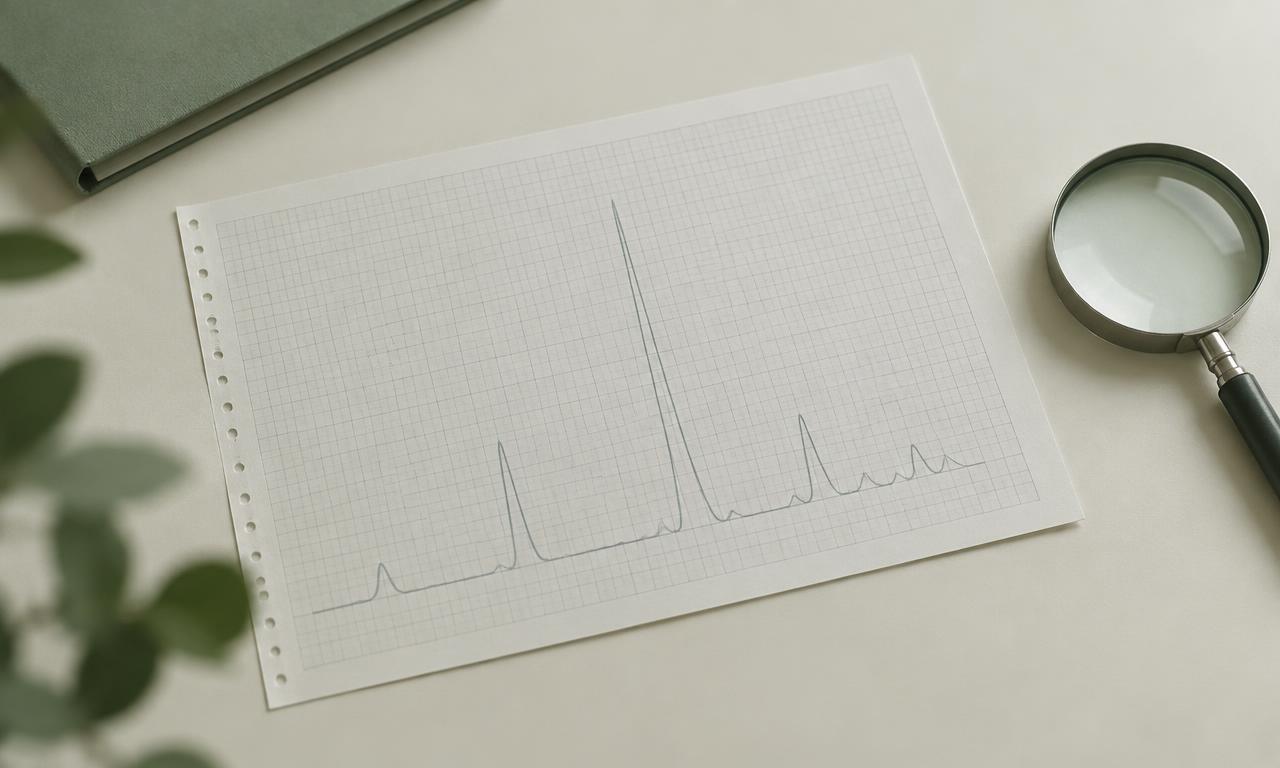
Almost always it refers to a chromatographic result — typically reversed-phase HPLC with UV detection. The instrument separates the components of an injected sample over time and records a signal for each. The purity figure is normally the area of the main peak expressed as a percentage of the total detected peak area.
Read carefully, that is a statement about relative proportions of what the method detected under those conditions. It is a useful and meaningful figure. It is also a narrower one than it appears.
A chromatographic purity result does not, by itself, establish: the identity of the main peak; the mass of peptide in the vial; sterility; endotoxin status; the presence of substances the method cannot detect (for example, species with no UV chromophore at the wavelength used, or material that does not elute); or that other vials match the one tested.
Each of those needs its own method. Pharmaceutical quality frameworks treat identity, assay/content, and impurities as separate tests with separate acceptance criteria for exactly this reason. [2]
What is peptide content?
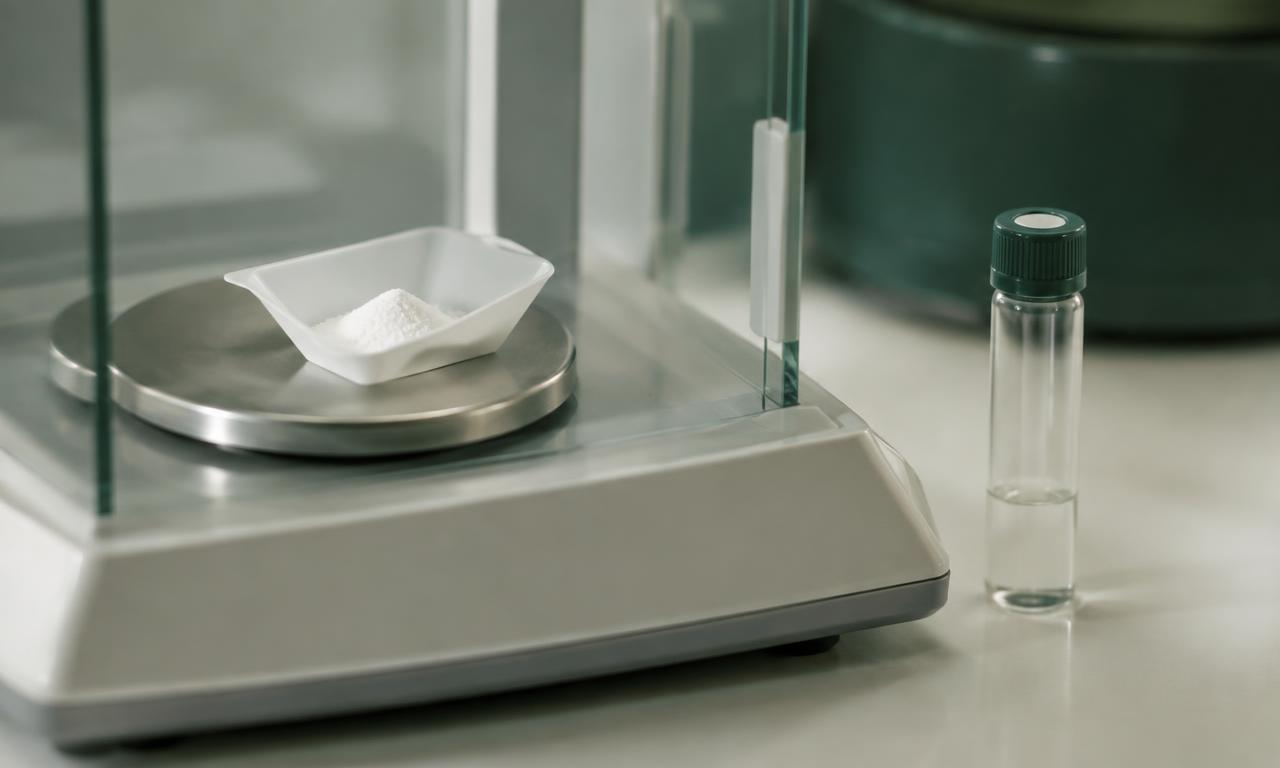
Content — sometimes called assay, quantity or net peptide content — is the amount of the target peptide in the sample, typically in milligrams per vial. It is a mass measurement, not a ratio.
Content matters because a lyophilised vial contains more than peptide. Depending on the material, it may also contain water, counterions from synthesis and purification (commonly acetate or trifluoroacetate), and excipients. The total powder weight is therefore not the peptide weight.
Establishing content requires a quantitative method calibrated against a reference — for example, quantitative HPLC against a standard of known concentration, or amino acid analysis. Published comparisons of peptide quantification approaches show that different methods can return meaningfully different values for the same material, which is why the method used should always be stated. [4]
Why can purity and content be different?
Consider a straightforward educational case, with no real data attached to it.
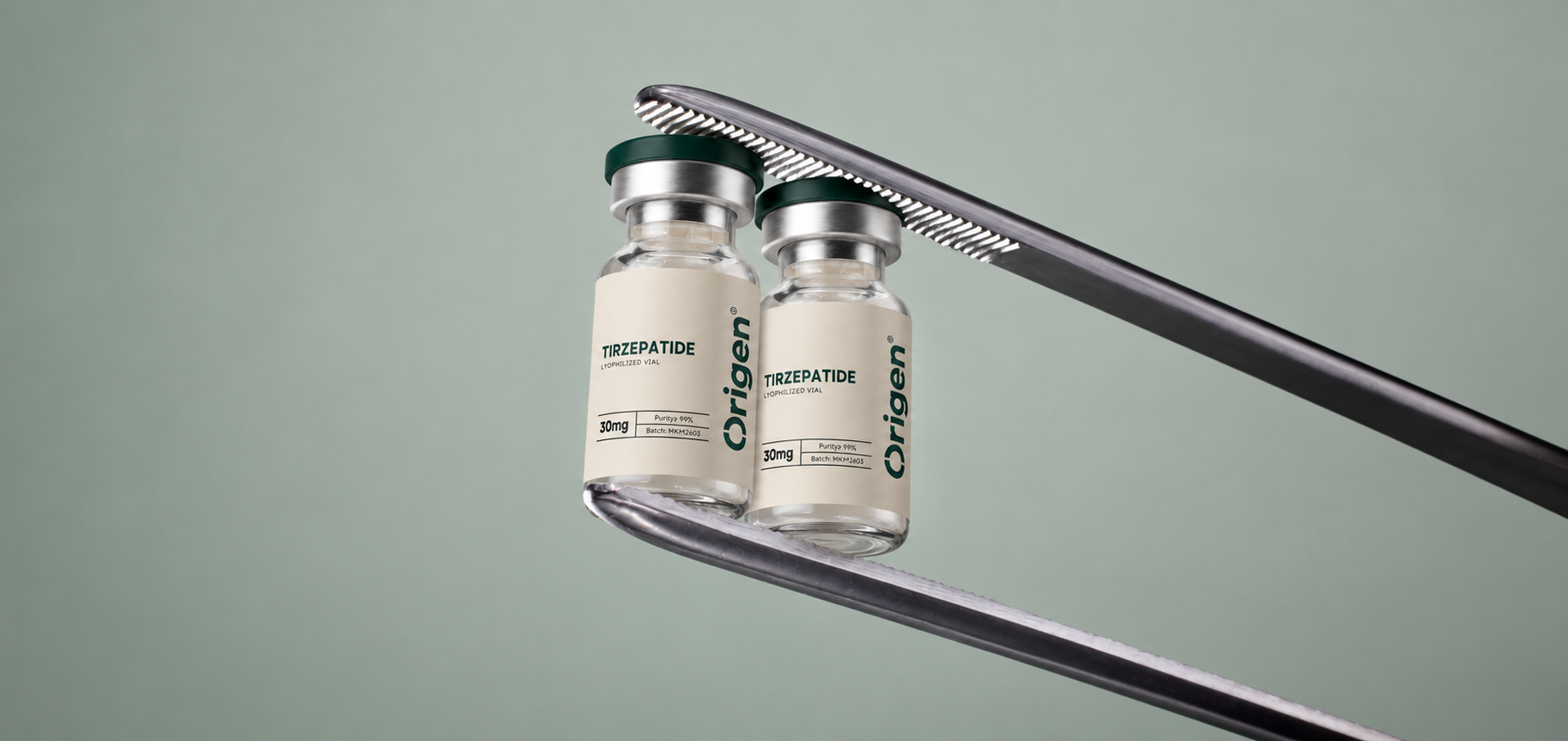
A vial is labelled 10 mg. The laboratory reports 99.5% purity by HPLC. That result says the detected peptide-related material was overwhelmingly the target species — it says nothing about whether the vial holds 10 mg, 9 mg or 11 mg of that species. Those two facts can move independently: a vial can be underfilled with very pure material, or generously filled with less pure material.
This is why reports that state both a quantity and a purity are more informative than reports that state only one. Origen's published reports state a reported content in milligrams alongside the HPLC purity result where both were performed — for example, the Retatrutide 30 mg report gives a reported content of 29.82 mg and a purity of 99.761%. [6]
Those figures, and the task numbers that let anyone re-check them, are published in full on the certificate library.
What does HPLC measure?
High-performance liquid chromatography pushes a dissolved sample through a packed column. Components travel at different speeds according to how strongly they interact with the column material, so they emerge separated in time and are recorded as peaks by a detector.
What that produces is a separation profile. With a suitable reference standard and calibration it can also produce a quantitative result. Which of those a given report contains depends on how the method was set up and validated — validation of an analytical procedure for identification, impurity testing or assay is treated as three different exercises in quality guidance. [1]
HPLC does not identify a molecule on its own. A retention time matching a standard is supportive evidence of identity; it is not structural confirmation.
What does mass spectrometry tell researchers?
Mass spectrometry measures mass-to-charge ratio, which allows the molecular mass of a species to be determined. Where a report includes an identity test by mass spectrometry, the useful statement is that the measured mass is consistent with the expected molecular mass of the target peptide.
That is a much stronger basis for an identity claim than retention time alone, and it is why identity and purity are best read together. It still does not measure how much material is present unless the method was specifically designed and calibrated to quantify.
What other tests may matter?
Which tests are relevant depends entirely on the material and the research context. The general categories used in pharmaceutical specifications include: [2][3]
- Identity — confirming the substance is what it is said to be.
- Assay or content — how much of it is present.
- Purity and related substances — the proportion and profile of impurities.
- Water content — relevant for lyophilised material.
- Residual solvents — covered by ICH Q3C.
- Counterions — acetate or trifluoroacetate content, which affects net peptide weight.
- Elemental impurities and heavy metals — covered by ICH Q3D.
- Bacterial endotoxin — a specific microbiological test.
- Sterility — a separate test again; endotoxin testing is not a sterility test.
This list describes what analytical chemistry can measure. It is not a claim that every peptide requires every test, and it is not a description of Origen's testing. Origen publishes the reports it has; the tests covered vary by product and are listed against each report rather than implied.
How should researchers read a purity claim?
A purity figure without context is close to meaningless. These are the elements that give it meaning:
- Method — which analytical technique produced the number, and at what detection wavelength if applicable.
- Laboratory — who performed the analysis, and whether they are independent of the seller.
- Sample identifier — what exactly was submitted and tested.
- Batch or lot relationship — how the tested sample relates to the material being supplied.
- Date — when the analysis was performed.
- Result — the reported figure, with the units and basis stated.
- Verification route — whether the report can be re-checked at the laboratory rather than taken from a seller's image.
- Scope — which tests were performed, and therefore which questions the document can answer.
The next article walks through those elements on an actual document: how to read a peptide certificate of analysis.
Frequently Asked Questions
Does 99% purity mean 99% of the vial is peptide?
No. A chromatographic purity figure describes the proportion of detected material that was the target peptide. It does not describe the mass of peptide in the vial, which requires a separate quantitative measurement.
Can a peptide be pure but underfilled?
Yes. Purity and content are independent measurements. That is why reports stating both are more informative than reports stating only purity.
Does HPLC confirm identity?
Not by itself. Retention time matching a standard is supportive, but structural confirmation generally requires a method such as mass spectrometry.