Why does the naming matter before anything else?
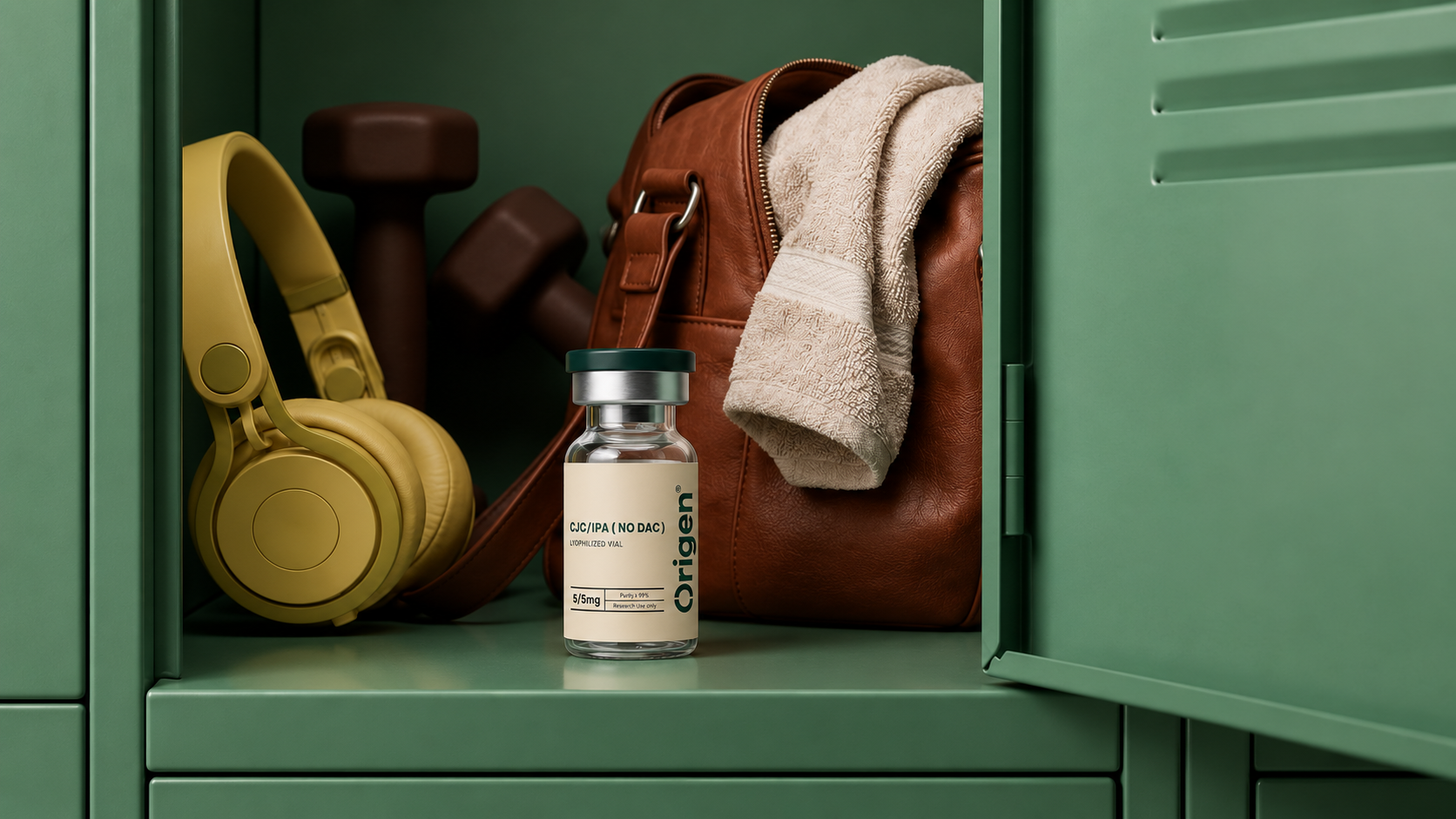
Very little else in this article makes sense without the naming distinction, so it comes first. CJC-1295 with DAC carries a Drug Affinity Complex, a chemical group that lets the molecule attach itself to albumin, the most abundant protein in blood, shortly after injection. Attaching to albumin dramatically slows how quickly the body clears it. CJC-1295 without DAC, also sold as modified GRF(1-29), lacks that group entirely and is cleared within about half an hour.
Those are therefore two compounds with the same commercial name and radically different behaviour in the body. The United States Food and Drug Administration's own 2024 compounding advisory review treated the DAC and non-DAC forms as separate bulk substances, which is the clearest possible confirmation that the distinction is real and not a technicality. [1]
| Name | What it is | Approximate duration |
|---|---|---|
| CJC-1295 with DAC | Tetra-substituted GHRH(1-29) analogue with an albumin-binding group | Estimated half-life of 5.8 to 8.1 days |
| CJC-1295 without DAC / modified GRF(1-29) | The same substituted GHRH(1-29) analogue without the albumin-binding group | Short-acting, on the order of minutes |
| Sermorelin | GHRH(1-29) amide, the unmodified natural fragment | Short-acting |
| Ipamorelin | A five-amino-acid ghrelin receptor agonist, unrelated to GHRH | Short-acting |
The DAC distinction is covered in depth in CJC-1295 with DAC versus without DAC.
How does CJC-1295 work?
HUMAN — PHASE 1 AND PHARMACODYNAMIC STUDIES
CJC-1295 is an analogue of growth hormone releasing hormone, the signal the hypothalamus sends to the pituitary gland to tell it to release growth hormone. It binds the GHRH receptor, a G-protein-coupled receptor on the pituitary cells called somatotrophs. Binding activates an internal signalling cascade involving cyclic AMP and protein kinase A, which drives growth hormone synthesis and release, the same pathway the body's own GHRH uses.
The substitutions built into the molecule make it resistant to DPP-IV, an enzyme that rapidly degrades natural GHRH. The DAC group then adds albumin attachment on top of that, extending duration from minutes to days.
| Study design | Detail |
|---|---|
| Design | Two trials: a 28-day single-dose study and a 49-day multiple-dose study |
| Participants | Healthy adults aged 21 to 61, across two sites |
| Compound | CJC-1295 with DAC, given subcutaneously |
| Endpoint | Result |
| Growth hormone | Two- to ten-fold increases sustained for at least six days after a single dose |
| IGF-I | 1.5- to 3-fold increases sustained for nine to eleven days |
| Estimated half-life | 5.8 to 8.1 days |
| Safety | No serious adverse events reported; best tolerability at 30 or 60 micrograms per kilogram |
A second study asked a subtler question: does continuous stimulation flatten the body's natural rhythm of growth hormone release? Growth hormone is normally secreted in pulses, mostly at night, and losing that pattern would be a meaningful biological change. Sampling every 20 minutes over 12 overnight hours in healthy men before and one week after a single injection, the researchers found pulse frequency and magnitude unchanged, while basal trough growth hormone rose 7.5-fold, mean secretion rose 46% and IGF-I rose 45%. [4]
Development of CJC-1295 was discontinued. A phase 2 trial in HIV-associated lipodystrophy was halted in 2006 following a participant death; the sponsor's investigation described the relationship to study drug as inconclusive. That registry record remains public.
How does ipamorelin work?
PRECLINICAL — CELL, RAT AND SWINE MODELS
Ipamorelin acts on a completely different receptor: GHS-R1a, the growth hormone secretagogue receptor, which is the receptor for ghrelin, the hormone produced in the stomach that signals hunger and also stimulates growth hormone release. Because this is a second, parallel input to the same pituitary cells, ipamorelin is described as a secretagogue rather than a GHRH analogue.
The founding pharmacology paper reported concrete values: in rat pituitary cells, a half-maximal effective concentration of 1.3 nanomolar with a maximum effect of 85% relative to the comparator GHRP-6; in anaesthetised rats, a half-maximal effective dose of 80 nanomoles per kilogram; and in conscious swine, 2.3 nanomoles per kilogram. [5]
The finding that gave ipamorelin its reputation was about selectivity rather than potency. Other growth hormone secretagogues of the same era also raised ACTH and cortisol, stress-axis hormones whose elevation is generally unwanted. Ipamorelin did not significantly raise either, even at doses more than 200 times its growth-hormone effective dose, which is why it was described as the first selective growth hormone secretagogue. In swine, none of the compounds tested affected FSH, LH, prolactin or TSH. [5]
Ipamorelin's only substantial human clinical data come from a different field entirely. A phase 2 randomised placebo-controlled trial tested intravenous ipamorelin for gastrointestinal recovery after bowel surgery in 117 enrolled participants, reporting a median time to first tolerated solid meal of 25.3 hours against 32.6 hours on placebo. A larger 320-participant dose-finding trial was registered and completed; no peer-reviewed publication of its results was identifiable. [6][7]
What is known about using them together?
HUMAN — NO DIRECT EVIDENCE
This is a negative finding, and it is a firm one. A search of the indexed biomedical literature and of ClinicalTrials.gov identified no published human study and no registered clinical trial testing CJC-1295 and ipamorelin as a combination. The pairing is a commercial convention, not an evidence-based protocol.
There is a real scientific idea underneath it, which is worth stating accurately. Studies from the 1990s showed that combining GHRH with GHRP-6, a different ghrelin-receptor agonist, produced growth hormone release far greater than either alone: in one study the combined growth hormone area under the curve was roughly 4,412 against 973 for GHRP-6 alone and 821 for GHRH alone. A later study using a GHRH antagonist showed that GHRP-6's effect depends substantially on intact GHRH signalling, which explains mechanistically why the two pathways amplify each other. [8]
Those studies used different molecules. Extending their conclusion to CJC-1295 plus ipamorelin specifically is an inference from related pharmacology, not a finding. This library treats it as a hypothesis with mechanistic support and no direct evidence.
The combination evidence question is examined further in CJC-1295 and ipamorelin research evidence.
What is the regulatory status?
- Neither compound is approved by any regulator for any indication.
- CJC-1295 in five chemical forms was reviewed by the United States Food and Drug Administration's Pharmacy Compounding Advisory Committee in December 2024; it does not appear on the final list of substances permitted for that use.
- Ipamorelin development for postoperative gastrointestinal recovery did not lead to approval.
- Both fall within the World Anti-Doping Agency's S2 category covering peptide hormones, growth factors and related mimetics, prohibited at all times in sport.
- Origen supplies these compounds as research material for laboratory use only. Nothing here is a dosing protocol or a therapeutic recommendation.
Frequently Asked Questions
Are CJC-1295 and ipamorelin the same kind of compound?
No. CJC-1295 is an analogue of growth hormone releasing hormone and acts on the GHRH receptor. Ipamorelin is a five-amino-acid ghrelin receptor agonist acting on GHS-R1a. They are structurally unrelated and act on different receptors.
What is DAC and why does it matter?
DAC stands for Drug Affinity Complex, a chemical group that lets CJC-1295 bind to albumin in the blood after injection, extending its estimated half-life to 5.8 to 8.1 days. Without it, the same peptide is cleared within about half an hour. Every published human study of CJC-1295 used the DAC form.
Has the combination of CJC-1295 and ipamorelin been studied?
No published human study and no registered clinical trial of the two used together was identifiable. Synergy has been demonstrated between GHRH and GHRP-6, which are different molecules, and applying that result to this specific pairing is an inference rather than evidence.
Why is ipamorelin called selective?
In its founding pharmacology study it stimulated growth hormone release without significantly raising ACTH or cortisol, even at doses more than 200 times its growth-hormone effective dose, unlike the comparator secretagogues tested alongside it.